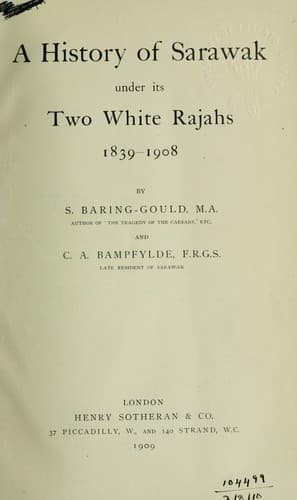
A History of Sarawak under Its Two White Rajahs 1839-1908Baring-Gould, S. (Sabine)
History
A History of Sarawak under Its Two White Rajahs 1839-1908
Baring-Gould, S. (Sabine)
Charles, Rajah of Sarawak, 1829-1917; James, Rajah of Sarawak, 1803-1868; Sarawak (Malaysia) -- History
Footnote 209:
Tien, heaven—ti, earth.
Footnote 210:
It is still part of the oath of the initiated, "I will use my utmost
endeavour to drive out the Chheng and establish the Beng dynasty."—
"Pickering, Chinese Secret Societies," in the _Journal_ of the Straits
Branch of the Royal Asiatic Society, 1878.
Footnote 211:
Pickering, who knew a good deal about the Society and wrote thereon,
had his life attempted, and, though not killed, was badly crippled.
Footnote 212:
Tai-pi-kong was the name of the joss.
Footnote 213:
The Chinese, holding the Rajah to be invulnerable, and being greatly
in fear of him, purposely left the exit by the door of the bathroom
unguarded.
Footnote 214:
He had joined the Sarawak service the year before. He was a brother of
Colonel Nicholetts, who was married to a sister of the present Rajah.
Footnote 215:
A Mr. Wellington was killed trying to defend Mrs. Middleton and her
children. He was a clerk in the Borneo Company, and had only lately
joined.
Footnote 216:
St. John says thirty-seven, five of whom died before the Bishop's
arrival.
Footnote 217:
Spenser St. John, _Life of Sir James Brooke_, to whom we are mainly
indebted for the following particulars we give of the insurrection.
Footnote 218:
A Saribas Malay Chief, and a staunch supporter of the Government.
Footnote 219:
_Ten Years in Sarawak._
Footnote 220:
Sir Spenser St. John, _op. cit._
Footnote 221:
Sir Spenser St. John, _Rajah Brooke_.
Footnote 222:
The Rajah to Mr. Templer.
Footnote 223:
Three Dots.
[Illustration:
MALAY CANNON (LELA) AND SPEARS.]
CHAPTER VII
THE SHERIP MASAHOR
When the Rajah assumed the Government of Sarawak, he had to look out for
suitable officials among the Malays to carry on the Government, and
suitable officials were not easily to be found where hitherto all had
been corruption and oppression. There is not much choice in rotten
apples.
There were three offices of importance to be filled: that of Datu
Patinggi, he who had the supervision and control over the tribes on the
left-hand branch of the river; that of Datu Bandar, he who held sway
over those on the right hand; and the Datu Temanggong, who had to look
after the tribes on the coast.[224]
Public-domain text, read in full here on John Shaqi.
Reviews
Reviews
No reviews yet
Be the first to share your thoughts on this work.
Elsewhere in the archive
Join the Discussion
Join the discussion
Sign in to leave a comment or review.
Sign InorCreate an account