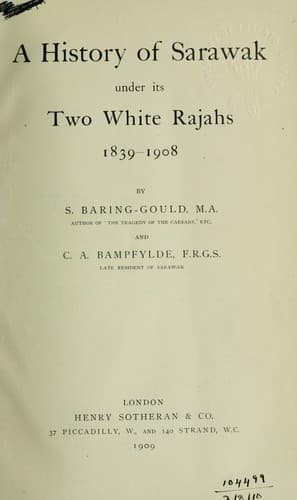
A History of Sarawak under Its Two White Rajahs 1839-1908Baring-Gould, S. (Sabine)
History
A History of Sarawak under Its Two White Rajahs 1839-1908
Baring-Gould, S. (Sabine)
Charles, Rajah of Sarawak, 1829-1917; James, Rajah of Sarawak, 1803-1868; Sarawak (Malaysia) -- History
In 1884-85, the Secret Society was in active revolt against the Dutch
Government, which was at first only able to hold the rebels in check,
not having sufficient forces to quell them. At Mandor, a large Chinese
town, they killed the Dutch official in charge, and burnt down the
Government buildings. After some hard fighting with great loss on both
sides, Mandor was surrendered by the rebels, upon the false promise of
an amnesty held out to them by the Sultan of Sambas. Finding themselves
deceived, the Chinese again broke out in rebellion, and seized the
important town of Mempawa, killing, amongst others, the Dutch officer in
charge, and driving the Dutch troops back. But their triumph was
short-lived, for upon the arrival of strong reinforcements the rebellion
was quelled. One of the principal leaders, the man who had shot the
Dutch controller of Mandor, was subsequently arrested in Sarawak, but
rather than face his fate he hanged himself by his queue in his cell the
day a Dutch gunboat had come round to fetch him.
In 1889, a secret society, allied with the Sam Tiam[223] or Ghee Hin
Hueh, a branch of the Triad Society of China, was established at
Segobang, the centre of a large district of Chinese pepper planters.
This Hueh had been formed by criminals and expelled members of the
Society from Mandor and Montrado. Their primary intention was to raise
another rebellion in Dutch territory, but they were banded by oath to
exterminate _all people without queues_. On July 15, the houses of the
chief and other known leaders were surrounded and searched, and the
inmates arrested. The documents seized clearly showed the objects of the
Society; that they had hundreds of men organised and ready for service;
and that they were in correspondence with the Ghee Hin Societies at
Mandor and Singapore. Six of the leaders were executed, and eleven
sentenced to penal servitude for life. One of the principals, who had
taken a leading part in the Mandor rebellion of 1884, was handed over to
the Dutch.
[Illustration:
A CHINESE PROCESSION.]
As late as 1906, one or two mysterious murders of Chinese in the Rejang
aroused the suspicions of the authorities, and it was found that a
secret society existed on that river. Valuable help was afforded the
Government by anonymous letters sent by law-abiding Chinese containing
minutely accurate information as to the members and their doings, which
led to the arrest of many, and to the discovery of incriminating
documents. This Society was called the Golden Orchid or Lily Society,
and was established at various places along the coast, from the Rejang
to Simatan. This was also a branch of the Triad Society, professing the
same great purpose, the reinstatement of the Ming dynasty in China, but
in practice its objects were murder, robbery, and violence. Eight of the
ringleaders were executed, and ten others sentenced to long terms of
imprisonment.
-----
Footnote 208:
Hueh, or Hui, is the Chinese word for a secret society.
Public-domain text, read in full here on John Shaqi.
Reviews
Reviews
No reviews yet
Be the first to share your thoughts on this work.
Elsewhere in the archive
Join the Discussion
Join the discussion
Sign in to leave a comment or review.
Sign InorCreate an account