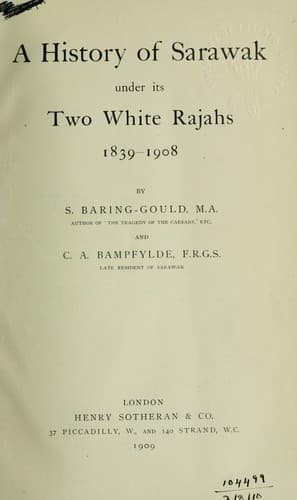
A History of Sarawak under Its Two White Rajahs 1839-1908Baring-Gould, S. (Sabine)
History
A History of Sarawak under Its Two White Rajahs 1839-1908
Baring-Gould, S. (Sabine)
Charles, Rajah of Sarawak, 1829-1917; James, Rajah of Sarawak, 1803-1868; Sarawak (Malaysia) -- History
The Datu Patinggi had a handsome daughter who was sought in marriage by
a certain Sherip Bujang, brother of Sherip Masahor of Serikei, who had
assumed the government of the Rejang river,[226] and had long been in
league with the Saribas and Sekrang pirates—an evil-minded and
intriguing man. The Rajah was very averse to this marriage, but could
not forbid it. And the result was that Gapur and Masahor put their heads
together, confided to each other their mutual grievances, and commenced
plotting against the Rajah and his officers. Serikei is 20 miles up the
Rejang river, which was not yet within the jurisdiction of Sarawak, but
Saribas and Sekrang were, and Masahor was a source of annoyance and
danger by incessantly fomenting agitation among the people of these
rivers against the Rajah's government, and supplying them with powder
and arms. For a while the Sadong district had been placed under the
charge of the Datu Patinggi as well as his own, but it was found that,
not satisfied with the salary paid by the Government in lieu of the
right of pre-emption, he was enforcing that same right and using great
oppression in both districts. The Tuan Besar, who was then administering
the Government, went from Kuching to make a tour in both these, and to
ascertain whether the rumours relative to the misconduct of Gapur were
true, and by this means sufficient proof of his illegal exactions was
obtained.
The Datu Patinggi had indeed pursued a course of oppression ever since
1851, when the marriage between Sherip Bujang and his daughter took
place. He had levied imposts on the Sarawak Dayaks, forced trade on the
Matu people, oppressed the Sadong Dayaks, and interfered at Lingga and
Serikei, and had even proceeded so far as to assume the insignia of
royalty by displaying a yellow (the royal colour) flag and unfurling a
yellow umbrella. He was then, in November 1853, brought up in Court,
publicly reprimanded, and made to disgorge his plunder. He submitted
with outward tokens of goodwill, but he had been publicly disgraced, and
this he did not forget. His feeling against the Government of the White
Man became more intensely bitter.
Early in 1854, the Rajah and Captain Brooke, the Tuan Besar, went up the
Batang Lupar river to visit the Tuan Muda at Lingga, and Brereton at
Sekrang; Mr. Spenser St. John was then at Kuching. This latter says:—
Public-domain text, read in full here on John Shaqi.
Reviews
Reviews
No reviews yet
Be the first to share your thoughts on this work.
Elsewhere in the archive
Join the Discussion
Join the discussion
Sign in to leave a comment or review.
Sign InorCreate an account