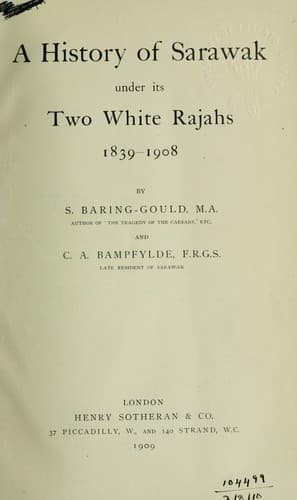
A History of Sarawak under Its Two White Rajahs 1839-1908Baring-Gould, S. (Sabine)
History
A History of Sarawak under Its Two White Rajahs 1839-1908
Baring-Gould, S. (Sabine)
Charles, Rajah of Sarawak, 1829-1917; James, Rajah of Sarawak, 1803-1868; Sarawak (Malaysia) -- History
One day, whilst sitting alone in my little cottage, the eldest son
of the Temanggong, Abang Patah, came in to have a talk. He was one
of the best of the Malay chiefs—frank, loyal, honest, brave as a
lion. He subsequently lost his life gallantly defending the Rajah's
Government.[227] I saw by his manner that he had something to
communicate, so after answering a few leading questions he said, "It
is no use beating about the bush, I must tell you what is going on."
He then unfolded the particulars of a plot which the Patinggi Gapur
had concocted to cut off the Europeans in Sarawak. The Patinggi had
confided his plans to the other chiefs, but they had almost
unanimously refused to aid him, and had determined to keep a watch
over his proceedings, but they had not the moral courage to denounce
him to the Government. At length Abang Patah said, "I have become
alarmed. The Rajah and Captain Brooke are away together. The
Patinggi is with them with all his armed followers, and in an
unsuspecting moment all the British officers might be cut off at a
blow." I promised, as he desired, to keep his communication a secret
from all but the Rajah, to whom I instantly wrote, giving not only
Patah's story, but other indications which had come to my knowledge.
An express boat carried my letter to its destination. The Rajah read
the letter, and, without a word, passed it to Captain Brooke. The
latter, having also read it, said, "What do you think?" "It is all
too true," answered the Rajah, to whom conviction came like an
inspiration. They had noticed some very odd proceedings on the part
of the Patinggi, but, having no suspicions, had not been able to
interpret some of his armed movements, but now it was quite clear
that he was trying to get the Europeans together to strike one
treacherous blow. Nothing, however, was said or done publicly. The
faithful were warned to watch well, and a few judicious inquiries
brought the whole story out.
The Commission had been despatched to sit at Singapore, on the conduct
of the Rajah. Gapur was well aware that the British Government was
indisposed to support the Rajah, and that there existed a body of
opinion in England distinctly and bitterly hostile to him, and certain
to apologise for any insurrectionary movement made to depose him, even
if it involved, as Gapur supposed, his being massacred along with his
English officers.
Mr. St. John goes on to say that upon his return to Kuching the Rajah
intended to bring the Patinggi to justice for this contemplated act of
treachery; but this was not done immediately. Before publicly convicting
and punishing the leading chief of the State, amongst whose relations
the Rajah could count so many staunch friends, it was thought advisable
to wait for some overt act which would afford clear and convincing proof
to all of the Datu's treachery.
Public-domain text, read in full here on John Shaqi.
Reviews
Reviews
No reviews yet
Be the first to share your thoughts on this work.
Elsewhere in the archive
Join the Discussion
Join the discussion
Sign in to leave a comment or review.
Sign InorCreate an account