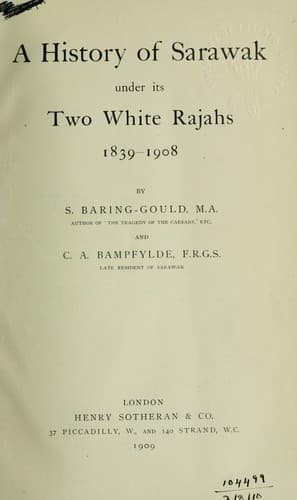
A History of Sarawak under Its Two White Rajahs 1839-1908Baring-Gould, S. (Sabine)
History
A History of Sarawak under Its Two White Rajahs 1839-1908
Baring-Gould, S. (Sabine)
Charles, Rajah of Sarawak, 1829-1917; James, Rajah of Sarawak, 1803-1868; Sarawak (Malaysia) -- History
This host surrounded the fortified house of Matusin, and Masahor, in the
name of the Rajah, called upon the former to surrender. He undertook, if
Matusin and his followers would come forth, with all the women and
children, and give themselves up, that their lives would not only be
spared, but that thenceforth they should all dwell together in amity. It
was agreed that this was to take place on the following morning. But
during the night a member of Masahor's party managed to get into the
house of Matusin to warn him that treachery was intended, and to urge
him to escape. This Matusin did in the dark, attended by six men only;
he fled up country, and made his way to Kuching, where he threw himself
on the protection of the Rajah. Next day Sherip Masahor, with his
ruffians, took most who remained in Matusin's house, and many of the
relations of the Muka chiefs who had supported him, to the number of
forty-five, chiefly women, massacred every one, and gave their heads to
his Saribas and Kanowit followers. As soon as the news reached Kuching,
the Tuan Muda was sent to Muka to inquire into matters. He says: "The
scene where the murders took place was then fresh with the marks of the
slaughtered wretches. Their torn clothes, the traces of blood and tracks
of feet, were plainly visible on the ground. In pulling up through the
Muka village, most of the houses were burnt down, and the graveyards
pillaged by Dayaks." Melanaus adorn their dead with costly gold
ornaments, which are buried with the bodies; this the Dayaks knew; to
attain these and the heads of the dead were their object in desecrating
the graves.
The people had lost their favourite leader and relative, Pangiran
Matusin; besides relations they had lost their homes and property, burnt
and pillaged by Masahor's followers on the ground that the owners had
favoured the slayer of Pangiran Ersat, and they were well aware that
they themselves were doomed, and all would most surely have been put to
death but for the arrival of the Tuan Muda. And now the poor creatures
surrounded him, and implored that an Englishman might be sent to govern
the place, and deliver them from the tyranny of the Bruni officials.
Having seen to the safety of Matusin's wife and children, who, with
other surviving relations and followers, were sent to Kuching, the Tuan
Muda returned to Sekrang. A fine was imposed on Sherip Masahor, and he
was forced to release 100 captives, and was deposed from his
governorship for having called out the Saribas under Sarawak rule for
warlike purposes. He was in league with the piratical party in the
Saribas, and not only supplied them with salt, which is an absolute
necessity to a Dayak, and which it was now difficult to obtain on the
Sarawak side, where the markets were closed to them, but also with
ammunition, and in other ways encouraged them in their opposition to the
Government. He left Serikei immediately, fearing further consequences.
Public-domain text, read in full here on John Shaqi.
Reviews
Reviews
No reviews yet
Be the first to share your thoughts on this work.
Elsewhere in the archive
Join the Discussion
Join the discussion
Sign in to leave a comment or review.
Sign InorCreate an account