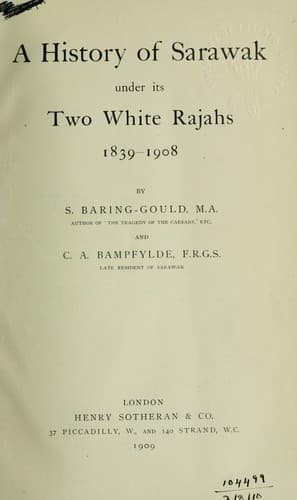
A History of Sarawak under Its Two White Rajahs 1839-1908Baring-Gould, S. (Sabine)
History
A History of Sarawak under Its Two White Rajahs 1839-1908
Baring-Gould, S. (Sabine)
Charles, Rajah of Sarawak, 1829-1917; James, Rajah of Sarawak, 1803-1868; Sarawak (Malaysia) -- History
A party of malcontent Saribas Dayaks had been induced by the Sherip to
settle in the Serikei river, to be handy agents for the execution of his
oppressive exactions, and the intrepid Penglima Seman was sent by the
Rajah to drive them out. This he did very effectually, and destroyed
their houses and stores. Shortly afterwards the Datu Temanggong and the
Datu Imaum dispersed a flotilla of some forty Saribas bangkongs which
they had met in the main river below Serikei.
The unsatisfactory condition of affairs in the Muka and adjacent
districts led the Rajah to pay another visit to Bruni, and thither he
sailed in June, 1855, after having despatched the Tuan Muda to Muka. He
went up in his little gunboat, the _Jolly Bachelor_, alone, and with no
retinue, no longer holding high offices under the Crown, "the castaway
of his own country." But he was most cordially received, and entertained
with due honours by the Sultan, by the Rajahs of both the hostile
factions, and by the people. All saw in the Rajah the possible
instrument to relieve them of the dissensions with which Bruni was
troubled, and which now verged upon civil war. Of the opposing factions,
which had existed ever since the days of Pangiran Usop, one party, and
by far the most powerful, was led by the Pangiran Anak Hasim, the late
Sultan's reputed son (who became Sultan in 1885), and this party was in
opposition to the Sultan, who had lost the support of nearly all his
people by becoming the tool of his cunning and grasping minister,
Pangiran Makota. "Trade had become a monopoly and thus been
extinguished; the exactions on the coast to the northward had produced
dissatisfaction and rebellion; the unfortunate people of Limbang, which
country is the granary of Bruni, was reduced to extremity, cruelly
plundered by Makota and his sons, and attacked by the Kayans, sometimes
at the instigation of Makota, sometimes on their own account; in short,
what Sarawak was formerly, Bruni was now fast becoming; and when I
pulled into the city in my little gunboat of thirty-five tons, four of
the Kampongs had their guns loaded and pointed against each other." Such
was the unhappy condition of the country as described by the Rajah.
The day after his coming the rival parties disarmed their
fortifications. The Sultan and the Rajahs placed the government in his
hands, with a request that he would endeavour to establish it on a
proper and firm basis, and promised obedience to all his directions.
Makota was absent, having been ordered by the Sultan to Muka to look
into matters there, which meant that he had been sent to plunder the
people of that and the neighbouring districts, but, though it angered
the Rajah, it rendered his task the easier.
Public-domain text, read in full here on John Shaqi.
Reviews
Reviews
No reviews yet
Be the first to share your thoughts on this work.
Elsewhere in the archive
Join the Discussion
Join the discussion
Sign in to leave a comment or review.
Sign InorCreate an account