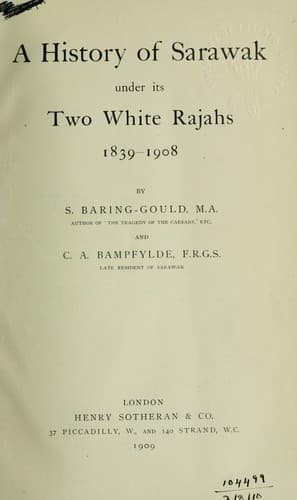
A History of Sarawak under Its Two White Rajahs 1839-1908Baring-Gould, S. (Sabine)
History
A History of Sarawak under Its Two White Rajahs 1839-1908
Baring-Gould, S. (Sabine)
Charles, Rajah of Sarawak, 1829-1917; James, Rajah of Sarawak, 1803-1868; Sarawak (Malaysia) -- History
Makota was now the sole minister, and the Rajah arranged that the old
executive system should be restored so as to counterbalance his
influence. The offices of the four ministers of State, or wazirs,
established by the ninth Sultan Hasan, early in the seventeenth century,
were revived; these were the Temanggong, the Bandahara, the di Gedong,
and the Pemancha. Though of ancient origin, by the will of autocratic
Sultans they had been in abeyance for many years, and their revival gave
confidence to nobles and people alike. They were never allowed again to
lapse.
Besides the above-mentioned functionaries, there are eight ministers of
the second class, all nobles; and lastly, a council of twelve officers
of state, chosen from among the leading people, the chiefs of the
different divisions or parishes of the city. These chiefs being elected
by the people renders this council representative.
Pangiran Anak Hasim became the Pangiran Temanggong. Though stern, he was
popular, governed well and fairly, and encouraged trade. His only
brother, the other doubtful son of Sultan Omar Ali, was made the
Pamancha. Now that the Rajah had succeeded in reconciling the hostile
factions, he trusted that the Pangiran Temanggong, with the assistance
of the other wazirs, supported by his own pledge to uphold them, with
force if necessary, against all disturbers of peace, would be able to
preserve the Sultan from the evil influence of Makota; indeed the Sultan
had a desire to act rightly, and his disposition was not altogether bad,
but avariciousness was his failing, and the means by which his evil
counsellors gained his ear.
The Rajah was pressed to take up his residence in Bruni, and, could he
have done so, all might have gone well, but he could not hope that his
present intervention would do more than postpone the downfall of the
worn-out and vicious Government, for the elements of discord and decay
were rife. And directly his back was turned the Sultan failed him. He
set aside the advice of his wazirs, and, to gratify his greed, upheld
Makota. He had promised that this man should be recalled from Muka, but,
instead of doing so, gave him a free hand to deal with the wretched
people as he pleased—to plunder for both himself and his master. The
Rajah then determined himself "to manage Makota, and to leave the Sultan
to rue his own folly"; the two factions in Bruni he trusted "would join
together to resist oppression, or, at any rate, forbear with each
other."
Public-domain text, read in full here on John Shaqi.
Reviews
Reviews
No reviews yet
Be the first to share your thoughts on this work.
Elsewhere in the archive
Join the Discussion
Join the discussion
Sign in to leave a comment or review.
Sign InorCreate an account