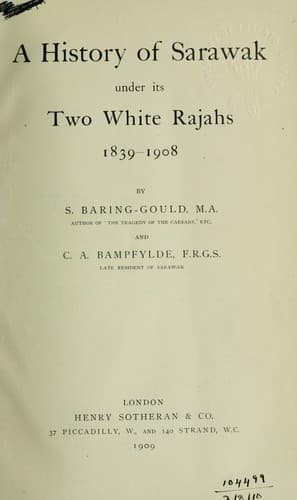
A History of Sarawak under Its Two White Rajahs 1839-1908Baring-Gould, S. (Sabine)
History
A History of Sarawak under Its Two White Rajahs 1839-1908
Baring-Gould, S. (Sabine)
Charles, Rajah of Sarawak, 1829-1917; James, Rajah of Sarawak, 1803-1868; Sarawak (Malaysia) -- History
Muka and Oya, where Pangiran Nipa had succeeded his father, Pangiran
Ersat, in power, being still in a very distracted condition, and the
Rajah, now being free of the troubles that had shaken the very
foundations of his own Government, and which had unavoidably withdrawn
his attention from these places, determined to make another effort to
establish order there in the interests of the suffering population, and
of the important trade between those places and Sarawak, which had now
almost ceased. For this purpose he again proceeded to Bruni in
September, 1857, and obtained full power to act at Muka, and authority
to intervene was granted him. At Muka the Rajah called together into his
presence the rival factions which had been murdering each other, and
disturbing the trade for the last four years. There were four hundred
persons present, including the Pangirans Matusin and Nipa, besides the
chiefs of the country, whose relatives had been put to death by Sherip
Masahor. The _chaps_[232]—the Sultan's mandates—were read, ordering
peace, and authorising the Rajah to punish any breach of it. The Rajah
then spoke to the people, pointing out the advantage of peace, and
pledging himself to punish any persons who by their actions should
disturb it. This visit of the Rajah was attended with good results, and
Muka enjoyed rest for a brief period.
In October, the Rajah proceeded to England, leaving the government in
the hands of the Tuan Besar; upon this visit, which was of necessity a
prolonged one, owing to the complete breakdown of his health, we will
touch later.
The month following the Rajah's departure, Pangiran Makota was violently
removed from the scene of his life's iniquities. We have already
recorded the manner of his well-merited death.[233] Of him the Rajah
wrote, "A greater villain it would be impossible to conceive, with heart
blacker, head more cunning, and passions more unrestrained. I say this
deliberately of a dead man." A fitting epitaph.
In December, Mrs. Brooke died, and the Tuan Besar left for England early
in 1859. Upon the Tuan Muda now fell the burden of the government at
perhaps the most critical period in the history of the raj. Plot was
heaped upon plot, and deceit and treachery faced him on all sides, but
by his courage, untiring energy, and determination the State was
successfully piloted through these grave troubles, its enemies
dispersed, and confidence restored to a panic-stricken people.
Public-domain text, read in full here on John Shaqi.
Reviews
Reviews
No reviews yet
Be the first to share your thoughts on this work.
Elsewhere in the archive
Join the Discussion
Join the discussion
Sign in to leave a comment or review.
Sign InorCreate an account