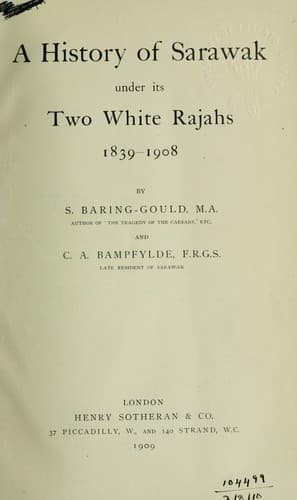
A History of Sarawak under Its Two White Rajahs 1839-1908Baring-Gould, S. (Sabine)
History
A History of Sarawak under Its Two White Rajahs 1839-1908
Baring-Gould, S. (Sabine)
Charles, Rajah of Sarawak, 1829-1917; James, Rajah of Sarawak, 1803-1868; Sarawak (Malaysia) -- History
Two years previously, Sherip Masahor and the Datu Patinggi Haji Gapur,
now known as the Datu Haji, had been pardoned. The former had been
allowed to return to Serikei, and the latter to live in retirement at
Kuching. It was a mistaken and highly imprudent policy, for neither had
forgotten his humiliation, and both commenced active intrigue against
the Government; and the party of pangirans at Bruni, hostile to all
reforms, were privy to these plots, of which the Sultan himself was
aware, and at which he probably connived. Constant intercourse was being
kept up between the Sultans of Bruni and Sambas, which could omen no
good to Sarawak; and Bruni alone, now once more relapsed into its former
evil condition, was without the means of open aggression.
In 1859, the Europeans in Sarawak were startled by a report of the
wholesale massacre of Europeans, men, women, and children, at
Banjermasin, succeeded by further reports that all white men were being
killed in the other Dutch settlements, and that the same fate was to be
meted out to those in Sarawak and Labuan.
In March, the Tuan Muda, owing to disquieting rumours having reached
him, resolved upon making a tour to the different stations on the coast,
and first visited the Rejang. At Serikei he was joined by Mr. Fox, and
then proceeded to Kanowit, a hundred miles up the broad Rejang river.
The village and fort together formed a picturesque piece of irregularity
and dilapidation. Here were settled a few Malays, a gang of cut-throats
who lived by swindling the Dayaks, and stood by the fort as their only
means of security. Some few Chinese traders had ventured to settle in
the place, but they were a mob of rapscallions. Above the village was
the mouth of the Kanowit river, and on the opposite bank of this river
was the large village of the Kanowit tribe, adherents of Sherip Masahor.
The Kanowit, as well as the Poi and Ngmah, two branches of the main
river above Kanowit, was inhabited by Sea-Dayaks from the Batang Lupar
and Saribas, unfriendly to the Government. Mr. Steele had been in charge
of Kanowit for eight years. It was a vastly solitary place for an
Englishman during the north-east monsoon. For three or four months of
the year no communication was to be had with Kuching, owing to the
strong freshes and heavy seas on the coast; but Mr. Steele had grown so
accustomed to the life that he would not have exchanged it for another.
The fort had been often attempted both secretly and openly, people close
around had been killed, and Mr. Steele had met with several narrow
escapes. His fortmen were not of the best class, but they were of his
own selection. The Tuan Muda felt uneasy about the place. "There was too
smooth an appearance, without any substantial base." There were no
reliable Malay chiefs; and he left Mr. Fox to support Mr. Steele.
Public-domain text, read in full here on John Shaqi.
Reviews
Reviews
No reviews yet
Be the first to share your thoughts on this work.
Elsewhere in the archive
Join the Discussion
Join the discussion
Sign in to leave a comment or review.
Sign InorCreate an account