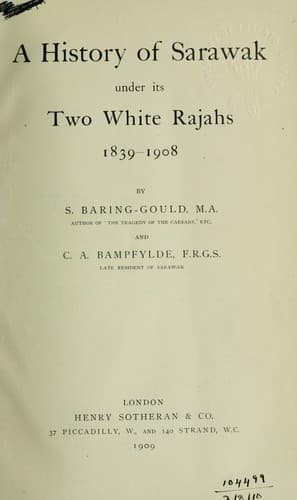
A History of Sarawak under Its Two White Rajahs 1839-1908Baring-Gould, S. (Sabine)
History
A History of Sarawak under Its Two White Rajahs 1839-1908
Baring-Gould, S. (Sabine)
Charles, Rajah of Sarawak, 1829-1917; James, Rajah of Sarawak, 1803-1868; Sarawak (Malaysia) -- History
Tani was caught and executed, though he protested his innocence, and on
being conveyed to death declared solemnly, "I am not guilty, before long
the true culprits will be discovered." It is perhaps to be regretted
that his life was not spared on condition of revealing the prime movers
of the plot. The case was most carefully investigated by the Tuan Muda
before sentence was passed, and the words he employed on his way to
execution showed that he had a knowledge of the conspiracy.
Mr. St. John more than hints that Tani was innocent. But at the time he
was not in Sarawak, but at Bruni, and did not again visit the Rejang.
There the justness of the execution of Tani has never been questioned,
even by his son, Buju, who succeeded him, and he was always spoken of as
one of the most active instigators of the murders. The Malays who were
in charge of the fort were also put to death for surrendering it without
a shred of resistance to the assassins, and allowing it to be plundered
of arms and ammunition, and everything it contained, and to be set on
fire. It was complicity, and not cowardice; and poor Steele had been
unwise in his selection of fortmen.
The Tuan Muda had brought the Datu Haji Gapur along with him,[237] not
deeming it prudent to leave him in Kuching unwatched, and now at Serikei
the Sherip Masahor came on board, and expressed his earnest desire to
accompany him up the river, and assist in the pursuit of the assassins
who had fled. He was urgent that his own armed men should surround the
Tuan Muda and act as bodyguard, but the offer was prudently declined.
This man was deeply suspected, but I could not find a clue, or a
tittle of evidence through which he might be brought to trial. I
thought all in this large river were more or less implicated, but we
could not put all to death, though conspiracy was rife. Some were
originators and instigators, some again the active workers; others
merely dupes, and some again only listeners, but none talebearers.
So my course was to meet the Sherip in a friendly manner without a
shadow of suspicion on my brow, and as he sat on one chair, I sat on
another within a foot of him. He had his sword, I had mine; both had
equally sharpened edges.
There were also present on deck a guard of armed blunderbuss men, and
the redoubtable old Subu,[238]
although I beckoned him away, he would take up his seat close to me,
with his gigantic sword at his waist. We sat and talked cordially on
various topics, and he (the Sherip) particularly recommended every
precaution, as he said he feared badly-disposed men were about. So
after an hour of this hollow friendship we separated, he going on
shore again. What would he not have given for my head!
The executions previously done by Masahor had been to get rid of awkward
witnesses to his having been an instigator of the crime.
Public-domain text, read in full here on John Shaqi.
Reviews
Reviews
No reviews yet
Be the first to share your thoughts on this work.
Elsewhere in the archive
Join the Discussion
Join the discussion
Sign in to leave a comment or review.
Sign InorCreate an account