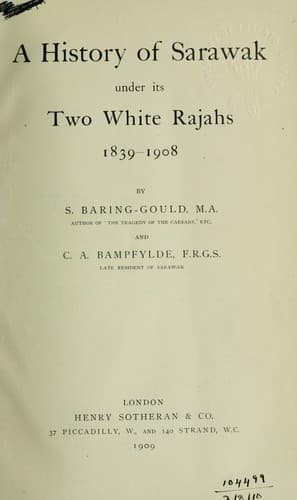
A History of Sarawak under Its Two White Rajahs 1839-1908Baring-Gould, S. (Sabine)
History
A History of Sarawak under Its Two White Rajahs 1839-1908
Baring-Gould, S. (Sabine)
Charles, Rajah of Sarawak, 1829-1917; James, Rajah of Sarawak, 1803-1868; Sarawak (Malaysia) -- History
Something had already been done, but much more yet remained. My wish
was to punish those immediately implicated, before touching the
instigators. I could only get at the former by the assistance of the
latter.
I felt apprehensive that I should have difficulties with my own
people after they had witnessed such severe proceedings, but was
determined to carry out my original resolve, and permit nothing to
shake me. I felt, while in this state, no more fear of danger or
death than of washing my hands in the morning. A man with arms
constantly about him, and death staring him in the face, soon loses
the sensation of what people improperly style nervousness. An
express boat was despatched to Kanowit for the remains of our late
friends, and they were buried at Serikei near the fort.[239]
The Tuan Muda lingered at Serikei as long as he could, waiting for the
Sekrang force, but as there were no signs of its coming he pushed on to
Kanowit, "where there was nothing to be seen but black desolation. The
poles and some fragments of the old houses were left, but nothing else.
The place looked as if it had been blighted by evil spirits."
Here he was informed that the Kanowits and others under Sawing and
Sakalai, two of the principals in the raid on Kanowit, had retired up
the Kabah, a branch stream of the Rejang a short distance above, and had
strongly fortified themselves there. Hundreds of Dayaks from the Kanowit
river now came and placed themselves at the Tuan Muda's disposal, but
they were his quondam enemies, and were but doubtful friends. To test
their professions of loyalty the Tuan Muda ordered them to proceed to
attack the enemy's fortification, and should they fail to take it they
were to surround it, so as to prevent the enemy decamping, and to await
his arrival. In the morning they left to execute this order.
Two days the Tuan Muda waited for his Sekrang reinforcements, whilst the
Malays were busy erecting a new fort, and then a young Dayak chief from
the advance party arrived with the information that they had failed in
their attack on the stockades, and had lost some killed and many
wounded, but they had obeyed the Tuan Muda's instructions, and had taken
up positions out of range all round the enemy's position—they begged
that he would speedily come to their assistance. They thus proved that
their hearts were well inclined; and these were the people that the Tuan
Muda had so severely punished three years previously.
Public-domain text, read in full here on John Shaqi.
Reviews
Reviews
No reviews yet
Be the first to share your thoughts on this work.
Elsewhere in the archive
Join the Discussion
Join the discussion
Sign in to leave a comment or review.
Sign InorCreate an account