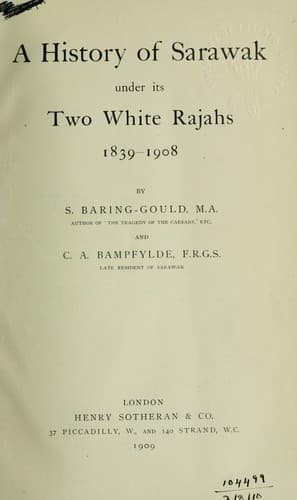
A History of Sarawak under Its Two White Rajahs 1839-1908Baring-Gould, S. (Sabine)
History
A History of Sarawak under Its Two White Rajahs 1839-1908
Baring-Gould, S. (Sabine)
Charles, Rajah of Sarawak, 1829-1917; James, Rajah of Sarawak, 1803-1868; Sarawak (Malaysia) -- History
hand-in-glove with the malcontents amongst the Saribas and Sadong
Malays, and was the cause of the revolt in the Sadong, due to his
connection the Bandar Kasim. He was at once sent to Singapore, not,
however, to remain there for long; and he shortly afterwards got himself
into further and more serious trouble. He had failed, but he knew others
would shortly be active, and he trusted to them to retrieve his failure,
and so prepared to join them directly they moved. Bayang, the principal
chief of the Dayaks, who had joined him, was imprisoned.
The discovery of this conspiracy, the murders of Steele and Fox, and the
knowledge that other plots were certainly brewing naturally created
great alarm amongst the English residents. No one felt safe, for none
knew the actual extent of these plots, or could distinguish between
friend and foe. The Government Officers were discouraged, for they felt
that the confidence created by long years of labour, anxiety, and kindly
intercourse between themselves and the natives was fast vanishing. Some
of the piratical Dayaks, who were being slowly but surely weaned from
their evil ways and induced to trade and plant, led astray by cunningly
devised reports, retired again to their fastnesses in the interior and
defied the Government; and it was feared that this disaffection might
spread.[242] Sir Spenser St. John writes:—
The gentlemen, to a man, stuck to their posts with firmness,[243]
the second class lost all courage; while the Bishop and some of the
missionaries left, the former taking home news that it was a
Mahomedan plot, with the Datu Imaum (the rival Mahomedan Bishop) at
the head of it—whereas the Datu Imaum showed himself, as ever, the
true and faithful friend of the English[244]—
and, we may add, true and faithful he remained for nearly fifty years
afterwards.[245]
The year of anxiety and careful watching closed without any further
outbreaks, but early in 1860 came the final episode, which ended in the
complete dispersion of conspiracies and conspirators.
Public-domain text, read in full here on John Shaqi.
Reviews
Reviews
No reviews yet
Be the first to share your thoughts on this work.
Elsewhere in the archive
Join the Discussion
Join the discussion
Sign in to leave a comment or review.
Sign InorCreate an account