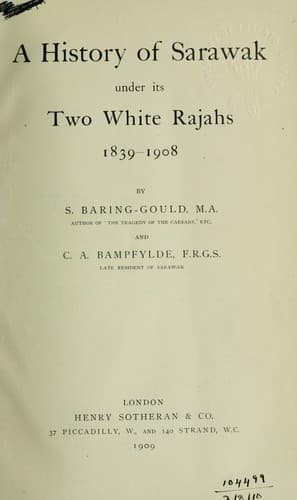
A History of Sarawak under Its Two White Rajahs 1839-1908Baring-Gould, S. (Sabine)
History
A History of Sarawak under Its Two White Rajahs 1839-1908
Baring-Gould, S. (Sabine)
Charles, Rajah of Sarawak, 1829-1917; James, Rajah of Sarawak, 1803-1868; Sarawak (Malaysia) -- History
The old Datu Temanggong was the first to warn the Tuan Muda. He went to
him, and, after taking the precaution of ordering all his followers out
of the room, told him to take care of himself, and not to ride and walk
about unarmed. He further observed that many suspicious reports were
flying about. The chiefs were at once assembled, and were unanimous in
recommending that the English officers should wear arms. "Why do we wear
arms?" they said, "because we cannot trust our neighbours." The Datu
Imaum added that he, being a haji, was not supposed to wear a sword, and
opening his robe showed a hidden kris, sharp as a razor. The Tuan Muda
was aware that it was useless asking them at this stage to give their
authority for these suspicions; he knew they were not yet prepared
openly to go further than to warn him to be on his guard—what had come
to their ears would be told him privately, and in due course of time.
Natives are extremely reticent and cautious at such times. The datus did
not wish to warn foes as well as friends, and were on their guard
against unsuspected spies and babbling tongues. The warning was rightly
regarded, and the Tuan Muda and his officers prepared to meet the
dangers that were brewing.
A few days later the Datu Haji's plot was revealed to the Tuan Muda, and
he acted with promptitude. "I assembled the chiefs, and acquainted them
that I should turn him out of the country immediately he returned, and
should prepare at once in case any opposition was shown." The chiefs
seemed satisfied, and said they were powerless with such an old and
morose man, and recommended me to use my own judgment in dealing with
him, engaging to assist me. Guns were loaded, and gunboats fenced in,
but everything was done quietly and without bustle. A guard was placed
in Government House, and the apertures were barred to prevent sudden
rushes. The day after the culprit returned and was informed that he had
to leave the country. Friendly people were mustered from neighbouring
rivers, and were lounging about in groups, ready at a moment's notice.
All wore arms and work was suspended. Next morning came, and the Sarawak
chiefs assembled the Nakodas (merchants) and population in the Native
Court.[240] The Bandar addressed them in these curt words: "I follow the
Sarawak Government; there is business to be done. All those who are
disposed to follow and assist me, hold up their hands." They all
responded favourably, and he then made known, "The Government banishes
Datu Haji and Nakoda Dulah,[241] as they are considered too dangerous to
live amongst us." Some of his relatives conveyed the news to him, and
told the Haji he had to leave the next day; an allowance would be
granted to him by the Government. Resistance was useless on his part. So
terminated this affair. He had been condemned in open court and by his
own connections, the Bandar and the Imaum. Although he had no, or very
little, influence in Kuching, he had in the country, for he was
Public-domain text, read in full here on John Shaqi.
Reviews
Reviews
No reviews yet
Be the first to share your thoughts on this work.
Elsewhere in the archive
Join the Discussion
Join the discussion
Sign in to leave a comment or review.
Sign InorCreate an account