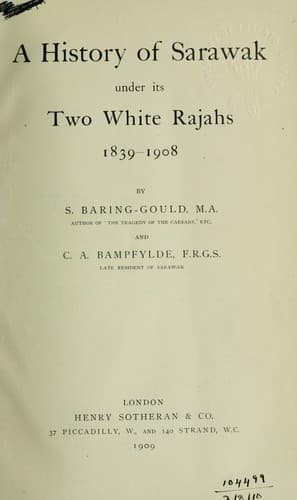
A History of Sarawak under Its Two White Rajahs 1839-1908Baring-Gould, S. (Sabine)
History
A History of Sarawak under Its Two White Rajahs 1839-1908
Baring-Gould, S. (Sabine)
Charles, Rajah of Sarawak, 1829-1917; James, Rajah of Sarawak, 1803-1868; Sarawak (Malaysia) -- History
Indifference to the fate of Sarawak had been openly expressed by the
British Government; consequently no helping hand had been proffered,
though the troubles with which the State was beset were well known. Even
the presence of a man-of-war, though she lent no active support, would
have exercised great moral effect. "Sarawak has been encouraged and
betrayed,"[249] in mournful anger wrote the Rajah, "England has betrayed
us beyond _all doubt_, and in the time of urgent peril cares nothing
whether we perish or survive."
In April, Captain Brooke, the Tuan Besar, returned to Sarawak and
resumed his duties as head of the Government. His brother's arrival
released the Tuan Muda from his duties at the capital, and left him free
to devote his time to the more active work yet to be done in the
provinces, where his presence was needed to reassure the people; and
there were still the refractory Dayaks of the Serikei and Nyalong to be
subjected, and Rentap to be smoked out of his lair.
Tunjang's fate is not recorded. The Dutch offered to deliver him up for
punishment, but it was left to them to deal with him, and no doubt they
dealt severely. The Datu Haji died at Malacca, and Bandar Kasim in
Kuching. The confiscation of his property was deemed sufficient
punishment, but he was not permitted to return to Sadong. The last phase
of Sherip Masahor is recorded in the next chapter.
We will now briefly follow the Rajah's movements in England, whither he
had gone mainly for a rest, which was, however, denied him. To add to
the mental worries caused by intense desire to safeguard the future of
his adopted country, he was visited by a grave bodily affliction.
His reception by Court and by Ministers was more cordial than on his
previous visit to England, and he was publicly entertained at Liverpool
and Manchester, but shortly afterwards he was struck down by a stroke of
paralysis. Though some months passed before he recovered his bodily
strength, the vigour of his mind remained unimpaired.
In his efforts to obtain protection he was backed by many influential
friends, and by public bodies. The Birmingham Chamber of Commerce
memorialised the Government to restore the protection afforded to
Sarawak up to 1851, and a large and influential deputation, representing
the mercantile interests of Liverpool, Manchester, Glasgow, and, to some
extent, London, with several members of Parliament, waited upon Lord
Derby with the same object. Lord Derby's refusal was severely commented
upon by the _Times_, and it occasioned a difference in the Cabinet. The
subject would again have been entertained, had not the Government
shortly afterwards gone out on their Reform Bill.[250]
Public-domain text, read in full here on John Shaqi.
Reviews
Reviews
No reviews yet
Be the first to share your thoughts on this work.
Elsewhere in the archive
Join the Discussion
Join the discussion
Sign in to leave a comment or review.
Sign InorCreate an account