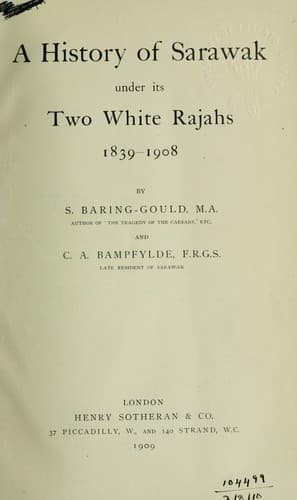
A History of Sarawak under Its Two White Rajahs 1839-1908Baring-Gould, S. (Sabine)
History
A History of Sarawak under Its Two White Rajahs 1839-1908
Baring-Gould, S. (Sabine)
Charles, Rajah of Sarawak, 1829-1917; James, Rajah of Sarawak, 1803-1868; Sarawak (Malaysia) -- History
The Rajah was left with but little hope. He felt that the Government of
both parties desired to be rid of Sarawak, and that the country was
indifferent; moreover he was fully assured that Sarawak could not stand
alone. England failing, Holland was tried, but "Holland," he writes,
"declares openly that there is an understanding the country shall fall
to them after my death." Then France was tried; and the protection of
France, the Rajah was of opinion, could have been gained had the Tuan
Besar been whole-hearted in the negotiations. But the Tuan Besar did not
share the Rajah's opinion that Sarawak could not maintain its
independence unsupported, and disliked the idea of handing the country
over to a Foreign Power, and in this he was supported by the Tuan Muda.
The Rajah wisely gave way to what has since proved to be the better
judgment of his nephews, and he wrote to the Tuan Muda, "as my views for
Sarawak are at an end, and as we are now to run the risk, with a
rational prospect of success, to sustain the Government I will loyally
and cheerfully work to falsify my own convictions. Time brings changes,
and may work upon the British Government. But it was a fatal mistake to
let slip an opportunity of safety, recognition, and permanency,[251] and
to allow an English prejudice to interfere with Sarawak. However, it is
past, and the juncture requires union, and united we will cheerily
work,"—and time was very shortly to work on the British Government in
favour of Sarawak.
But pecuniary failure was also staring Sarawak in the face. The Borneo
Company, Limited, suffering under severe losses consequent on the
Chinese insurrection and the continued disturbed state of the country,
were losing heart; they considered it advisable to withdraw from
Sarawak, and such a step on their part would have been fatal to the
investment of further British capital in the country. In the next place,
the Rajah was being pressed for repayment of a large sum of money,
which, for the purposes of the Government, he had found it necessary to
borrow after the ruin caused by the Chinese insurrection. But "the
Borneo Company persevered, and has long since reaped the benefit of so
doing,"[252] and a kind and ever staunch friend, Miss (afterwards
Baroness) Burdett-Coutts, relieved him of his pressing debt by a loan
free of interest. She further advanced the money to purchase a steamer,
a very urgent need, and the Rajah bought a little vessel which he named
the _Rainbow_—"the emblem of hope," and never was a rainbow after a
storm more welcome. Of her the Tuan Muda wrote that "she was welcomed as
a god-send of no ordinary description, whereby communication could be
quickly carried on and outposts relieved or reinforced within a short
time. She was the small piece of iron and machinery which could carry
Sarawak's flag, and raise the name of the Government in the minds of the
people along the coast."
[Illustration:
KANOWIT.]
Public-domain text, read in full here on John Shaqi.
Reviews
Reviews
No reviews yet
Be the first to share your thoughts on this work.
Elsewhere in the archive
Join the Discussion
Join the discussion
Sign in to leave a comment or review.
Sign InorCreate an account