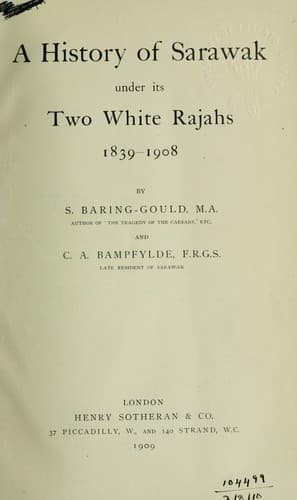
A History of Sarawak under Its Two White Rajahs 1839-1908Baring-Gould, S. (Sabine)
History
A History of Sarawak under Its Two White Rajahs 1839-1908
Baring-Gould, S. (Sabine)
Charles, Rajah of Sarawak, 1829-1917; James, Rajah of Sarawak, 1803-1868; Sarawak (Malaysia) -- History
Messrs. Watson and Cruickshank at Saribas, and Mr. Grant at Belidah.
In Kuching Messrs. Crookshank, R. Hay (who had joined in May 1857),
and Alderson, a son of Baron Alderson, who served for a short time
only.
Footnote 244:
_Life of Sir James Brooke._
Footnote 245:
He was better known in later days as the Datu Bandar.
Footnote 246:
_Ten Years in Sarawak._
Footnote 247:
The Sultan of Bruni affirmed to Consul-General St. John that the
Sherip was responsible for the murder of Steele and Fox.
Footnote 248:
A pension of 300 reals per mensem had been offered to any one taking
the Tuan Muda's head; the danger attached to such an undertaking was
evidently duly appreciated.
Footnote 249:
"Sarawak became virtually a protected State. Her ruler was appointed a
public officer of the Crown, and such unequivocal countenance and
support were given as to assure the natives, and to induce British
subjects to embark their lives and fortunes in the country."—The Rajah
to the Secretary of State for the Colonies. Nevertheless protection
and support were withheld.
The Governor of Singapore sent the H.E.I.C.'s steamer, _Hooghly_, in
November 1859, to safeguard British interests, but there was no need
of her services then, and she left almost immediately.
Footnote 250:
From Miss Jacobs, _The Raja of Sarawak_.
Footnote 251:
Referring to the protection of France.
Footnote 252:
Miss Jacobs, _op. cit._ For a special account of this Company see
Chap. XVI.
Footnote 253:
Sir Thomas Fairbairn, Bart.
[Illustration]
CHAPTER VIII
MUKA
In 1856, the Honourable G. W. Edwardes had been appointed Governor of
Labuan; Mr. Spenser St. John being Consul-General at Bruni. The Governor
was known to have imbibed all the prejudices and antipathies fostered in
England by Mr. Gladstone and his tail; and he was eager in everything to
hamper the development of the little State of Sarawak. He was not,
however, authorised to interfere in the relations between Bruni and
Sarawak, nor in the internal affairs of these States, where he had no
jurisdiction; but when the Consul-General left on leave early in 1860,
the Consular Office was handed over to him, and he was then placed in a
position to give vent to his bias, and, as Sir Spenser St. John remarks,
"he was delighted to get a chance of giving a blow to Sarawak." With
regard to Sherip Masahor, "he acted against his better judgment," and
with regard to the subsequent events at Muka "against the strong advice
of his own experienced officers."[254]
Public-domain text, read in full here on John Shaqi.
Reviews
Reviews
No reviews yet
Be the first to share your thoughts on this work.
Elsewhere in the archive
Join the Discussion
Join the discussion
Sign in to leave a comment or review.
Sign InorCreate an account