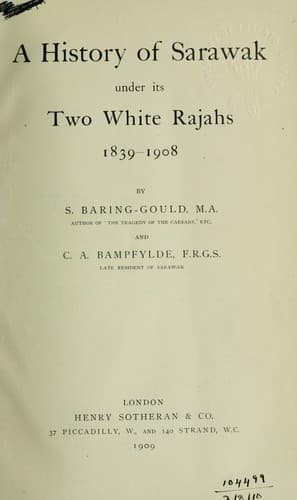
A History of Sarawak under Its Two White Rajahs 1839-1908Baring-Gould, S. (Sabine)
History
A History of Sarawak under Its Two White Rajahs 1839-1908
Baring-Gould, S. (Sabine)
Charles, Rajah of Sarawak, 1829-1917; James, Rajah of Sarawak, 1803-1868; Sarawak (Malaysia) -- History
His was a turbulent nature; a useful man in the time of trouble, but
apt to be troublesome in the time of peace. He had some fine
qualities, being brave and staunch, but even his best friend could not
have called him honest. A well-built muscular man, never ruffled, and
utterly impervious to fear, but somewhat cold-blooded—he was covered
with the marks of old wounds. When Muka fort was built, he was
appointed to be native Magistrate under the Resident, but he was
removed in 1868, being unprincipled, dishonest, and unjust (to quote
the present Rajah). He was invaluable in dealing with the turbulent
Dayaks in the upper waters of the Rejang, as they absolutely feared
him, but he could not keep his hands clean, and had to be removed from
Baleh in 1876, when he was pensioned and placed out of harm's way at a
little village near Santubong. He was a staunch supporter of
Government and a hard fighter in helping to maintain it; he died some
twenty years ago.
Footnote 232:
Chap (Hindustâni) meaning a seal. Hence a firman, edict, licence,
grant.
Footnote 233:
See Chap. III. p. 87.
Footnote 234:
A young man then, and one of the well disposed Malay chiefs of
Serikei. He shortly afterwards became the principal native officer in
the Rejang, a position which he held until his death in 1874. He
earned the fullest confidence of the Government, and the respect not
only of his own people, but of the Dayaks, Kayans, and other tribes.
Footnote 235:
A schooner belonging to the S.P.G. Mission.
Footnote 236:
The national method of execution.
Footnote 237:
From a letter from the Tuan Muda to his uncle, giving an account of
these events, it is, however, evident that Haji Gapur had wheedled
himself into the Tuan Muda's good graces, and had to a large extent
regained his confidence. The Haji begged to be with him, and was
taken.
Footnote 238:
A Singapore Malay, better known as Inchi Subu. He was one of the Malay
sailors engaged by the Rajah to serve on the _Royalist_ when he first
arrived at Singapore. He was remarkable for his size and strength. He
became personal orderly to the late Rajah; and afterwards to the
present Rajah, and was also the executioner. A brave and trustworthy
man, he was generally popular with Europeans as well as natives. He
died some years ago.
Footnote 239:
Afterwards re-interred in the Kuching cemetery.
Footnote 240:
A Court set apart for the settlement of Probate and Divorce cases and
other civil suits arising amongst Muhammadans, and which are settled
in accordance with Muhammadan law. Presided over by the Datus.
Footnote 241:
A relation of the Datu Haji. He had been very active inciting the
people of Lundu to revolt.
Footnote 242:
It must be borne in mind that Rentap was still at Sadok defying the
Government.
Footnote 243:
Public-domain text, read in full here on John Shaqi.
Reviews
Reviews
No reviews yet
Be the first to share your thoughts on this work.
Elsewhere in the archive
Join the Discussion
Join the discussion
Sign in to leave a comment or review.
Sign InorCreate an account