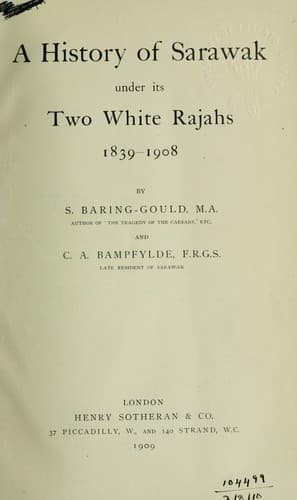
A History of Sarawak under Its Two White Rajahs 1839-1908Baring-Gould, S. (Sabine)
History
A History of Sarawak under Its Two White Rajahs 1839-1908
Baring-Gould, S. (Sabine)
Charles, Rajah of Sarawak, 1829-1917; James, Rajah of Sarawak, 1803-1868; Sarawak (Malaysia) -- History
On the 24th, at starting the contingent consisted of sixty boats, with
an average of forty men in each, and pushed up the mouth of the Rejang
to Serikei, and Mr. Watson had gone on with forty boats from Saribas. On
the following day Sibu was reached, where lived the Banyoks. Tani had
been their chief, the conspirator who had been sentenced to death by the
Tuan Muda, as mentioned in a previous chapter. But now Tani's son,
Buju,[282] at the head of his fighting men, readily joined forces to
those of the Tuan Muda. On the 29th at 2 A.M. by hard paddling, Kanowit
was reached. "At daylight our force had congregated about the village
and on each bank of the river, which was so broad that thousands of
boats would not have made much show. After having coffee, I commenced
work with Sergeant Lees in examining all the stores, arms, and
ammunition. The heavy guns and shot had been already despatched by the
Kanowit and Katibas boats, which were now two days' start ahead of us. I
had arranged that the foot of the first rapids should be our rendezvous,
and the enemy were reported to be six days distant above this point. It
took the greater part of the day distributing arms, ammunition, and
sundry other things to be carried by the force. Our Europeans of the
party were Messrs. Watson, Cruickshank, my younger brother, Sergeant
Lees, and Lucas (the Captain) of the _Venus_.
"_26th._—The principal natives persuaded me to remain over to-day or I
would have pushed on to lose no time in this fine weather. They require
time to settle many little matters with which they are particular. Some
made their wills, others sent letters to their nearest relatives,
acquainting them with their last wishes, and all our boats needed much
preparation. The one prepared for me, into which I had to shift all my
things, was sixty-six feet long, shaped like a coffin and totally devoid
of elegance and beauty. She consisted of a single tree hollowed out and
round at the bottom, but raised a little at her extremities. When the
hollowing out is done, a bow and a stern-piece are fastened with
rattans; they have not a nail in them; two light planks are also tied on
top and then they are complete. Some have much speed, and are capable of
carrying from forty to seventy men with a month's provision on board.
They are adapted for passing the rapids, are buoyant in the falls, and
the crews are able to use a long sweeping stroke with the paddles, such
as could not be managed in shorter boats.
"_29th._—As the fort clock struck eight, a gun was fired as a signal for
starting, and about eighty boats left together; others had been going on
during the night, and many were still behind. The current ran strong
against us, and we were forced to hug the bank.
"The banks above Kanowit are steep, and Kanowit itself may be said to be
the first pretty spot in the Rejang river, but above it is much variety
of scenery—windings of the river, hills and hillocks of every shape."
Public-domain text, read in full here on John Shaqi.
Reviews
Reviews
No reviews yet
Be the first to share your thoughts on this work.
Elsewhere in the archive
Join the Discussion
Join the discussion
Sign in to leave a comment or review.
Sign InorCreate an account