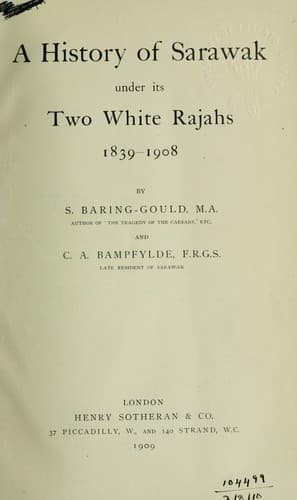
A History of Sarawak under Its Two White Rajahs 1839-1908Baring-Gould, S. (Sabine)
History
A History of Sarawak under Its Two White Rajahs 1839-1908
Baring-Gould, S. (Sabine)
Charles, Rajah of Sarawak, 1829-1917; James, Rajah of Sarawak, 1803-1868; Sarawak (Malaysia) -- History
As they ascended, ruined habitations and deserted paddy-fields were
passed, that had been ravaged by the Kayans; to put a term to their
violence a fort had been erected at Ngmah, between Katibas and Kanowit.
This was now dismantled by the Tuan Muda on his way up, and he took the
men and guns along with him. Above the junction of the Katibas with the
Rejang for over a hundred miles the country was uninhabited.
On the 31st, the Baleh river, the left hand branch of the Rejang, was
passed. Here the character of the scenery changes, the sides become
craggy, and the river rolls over masses of rock, and through veritable
gorges, with a swift current.
On June the 1st, the foot of the first rapid was reached, where the
rendezvous had been appointed. Here all those who had gone on before
were assembled in thousands. "Groups of Dayaks in all directions—some
lounging on rocks, or on the patches of white sand in the bight, others
mending their boats which they had hauled up in the most favourable
places. Many were squatting round fires and cooking. Bright colours of
clothes, flags, and painted boats were interspersed among them."
A council was held that same afternoon, and further proceedings were
discussed. A hundred chiefs were present, and the Tuan Muda spoke,
arranging the order of the bala, and insisting that the lives of women
and children must be spared, and that the chiefs should be held
responsible for the conduct of their followers. He was followed by
Balang, "an ugly little broad man, with the jowl of a hog," the chief of
Katibas, whose house had been burnt by the Kayans, all his property
carried off, and many of his relatives and people killed. "I have no
wish to return," said he, "if this expedition is unsuccessful. They may
cook my head if I can't cook theirs."[283] The force then consisted of
300 boats carrying 12,000 men.
On the following day the ascent of the Pelagus rapids was begun. The
boats were forced up by the men with poles in their hands, and were
aided by others on the banks hauling with ropes; whilst others again,
where the water was shallow, were immersed in it pulling and shoving.
"Men seemed like ducks in the water. Swimmers and divers all had their
duties, and the amount of exertion of this kind which the natives will
undergo is simply wonderful. They keep it up hour after hour in the
coldest mountain stream, jumping on to and over places where an
Englishman could not gain a foothold, as the rocks are slippery as
glass, and many of the ridges are not over three inches wide, making one
giddy to look at them."
Public-domain text, read in full here on John Shaqi.
Reviews
Reviews
No reviews yet
Be the first to share your thoughts on this work.
Elsewhere in the archive
Join the Discussion
Join the discussion
Sign in to leave a comment or review.
Sign InorCreate an account