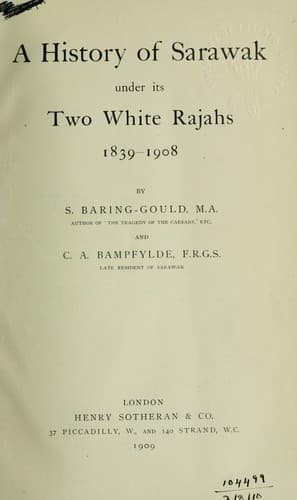
A History of Sarawak under Its Two White Rajahs 1839-1908Baring-Gould, S. (Sabine)
History
A History of Sarawak under Its Two White Rajahs 1839-1908
Baring-Gould, S. (Sabine)
Charles, Rajah of Sarawak, 1829-1917; James, Rajah of Sarawak, 1803-1868; Sarawak (Malaysia) -- History
After a while the first portion of the rapids was safely surmounted, and
a basin of calmly flowing water was reached. But this was not far, it
afforded a breathing space before the next difficult point was reached,
a perpendicular fall of ten feet. Here was a portage; provisions, arms,
and ammunition had to be carried by land, and the boats hauled over
sixty feet of a steep rocky incline, covered with water when the river
was full, but now left dry. In the process, however, a good many of the
boats went to pieces, and the crews had to be partitioned among the
others.
This was followed by another fall, that had to be surmounted in the same
way. "This last was a terrible job, and at every foot gained, I thought
my coffin would have gone in two, as she creaked piteously. But at last
we gained the summit of the first rapids. Here we stopped, as the crews
required rest, and the sun was piercingly hot." The whole length of this
first rapid is four miles, and the breadth of the river six hundred
yards. Not one third of the force had as yet surmounted it, and some
were discouraged and made no attempt to do so.
[Illustration:
KAYAN MORTUARY.]
Next day, the 3rd, the Tuan Muda's thirty-fourth birthday, the coffin
was advancing up stream where the river was broken up by islets and
running between them, like a mill race, followed by the boat containing
Mr. Cruickshank and Mr. Stuart Johnson, when, in punting, it was driven
against a submerged rock and at once began to fill. Seizing his gold
watch and chain, the Tuan Muda sprang into the water and swam to the
boat that followed and was taken in; but provisions, the Tuan Muda's
sword, spyglass, rugs, etc., all new from England, were irretrievably
lost, and the whole crew were boatless; for the coffin was whirled down
the stream.
"_4th._—We advanced again as usual, and after about an hour's hard
pulling and many ropes, the stream became smooth and deep, and no more
rocks were in sight. The reaches were long and straight, with a steady
current of two and a half knots. The land was level without being
swampy, and the soil appeared to be a rich yellow loam. What land for
agriculture! and it extends for miles."
They were now on the fringe of the Kayan country, and they came on the
remains of the house of the chief Akam Nipa, which he had deserted. The
enemy had retired before the advancing force, and not one had as yet
shown himself; though a small party, consisting of seven men, that had
gone into the jungle hunting, three days before, thinking that the
Kayans had all retreated, had incautiously lain down to sleep, when they
were captured, tortured slowly to death on the spot, and then
decapitated.
On the 6th, the Tekok rapids were encountered, and another abandoned
Kayan village passed. The hills now began to show, and the river to flow
over rocks and between bluffs. Had this spot been held by the enemy, it
would have been most difficult to pass, but they had considered it best
to retreat.
Public-domain text, read in full here on John Shaqi.
Reviews
Reviews
No reviews yet
Be the first to share your thoughts on this work.
Elsewhere in the archive
Join the Discussion
Join the discussion
Sign in to leave a comment or review.
Sign InorCreate an account