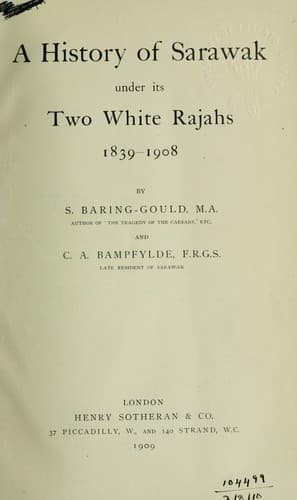
A History of Sarawak under Its Two White Rajahs 1839-1908Baring-Gould, S. (Sabine)
History
A History of Sarawak under Its Two White Rajahs 1839-1908
Baring-Gould, S. (Sabine)
Charles, Rajah of Sarawak, 1829-1917; James, Rajah of Sarawak, 1803-1868; Sarawak (Malaysia) -- History
On the return of the expedition, Kanowit was reached on the 17th, and
thence the Tuan Muda went back to his station at Sekrang, and waited
there for nearly a month before a deputation of Kayans arrived, bearing
the flag that had been left with the captive woman. They numbered
seventy men, and came to profess their desire for peace in the future.
They reported that their chief Oyong Hang had summoned the people to a
conference, and then and there had cut down Talip, and his followers had
put Sakalai to death, but Sawing, suspecting what would be the
determination of the Kayans, had escaped a few days previously.[286]
Accordingly the month of August was appointed for the gathering of a
large assembly of the tribes to conclude a peace with the Kayans. There
were, however, several hitches, and the meeting did not take place until
October.
"The Kayan peace was concluded this month, when the chiefs arrived at
Kanowit for that purpose. They met the Dyaks, and a pig was killed,
according to custom. The terms and points to be sacredly attended to
were all discussed before the Resident of the place. Some of the chiefs
of the Keniah country were also present, and expressed a desire for
trade and friendship. They talked of removing down the river. At this
meeting there were representatives of 25,000 souls, who were all
strangers to us, although living within the limits of Sarawak territory.
This peace had been the great event of the year 1863, and leaves Sarawak
without an enemy in her dominions, and without an intertribal war of any
description. This is the first time the country has had peace."
In December, Sawing, the last of the murderers of Fox and Steele, was
given up, tried, and executed.
"And now," says the Tuan Muda, "the deaths of those who were private
friends and public servants, and who had occupied a distant and isolated
out-station, have been completely avenged."
The Rajah remained in Sarawak till after the subjection of the Kayans,
and then, having handed over the Government to the Tuan Muda, left in
September, 1863, and "bade farewell to the people and the country he was
never to see again."
-----
Footnote 277:
From a letter of the Rajah's dated September 9, 1862.
Footnote 278:
Mr. G. T. Ricketts was appointed Consul, January 19, 1864.
Footnote 279:
Captain Brooke died the same year as the Rajah.
Footnote 280:
Oyong Hang was the chief of the Bintulu Kayans, and was at one time
friendly to the Government, but he had thrown off his allegiance and
joined Akam Nipa.
Oyong is prefixed to the name of a Kayan on the death of his
firstborn; Akam, on the death of a younger child.
Footnote 281:
_Ten Years in Sarawak_, from which this account is taken.
Footnote 282:
See chap. vii. p. 107.
Footnote 283:
For the fate of this chief see chap. xii. p. 320.
Footnote 284:
Belaga, where is now a strong fort, and a Chinese and Malay trading
station, is just above this.
Footnote 285:
Public-domain text, read in full here on John Shaqi.
Reviews
Reviews
No reviews yet
Be the first to share your thoughts on this work.
Elsewhere in the archive
Join the Discussion
Join the discussion
Sign in to leave a comment or review.
Sign InorCreate an account