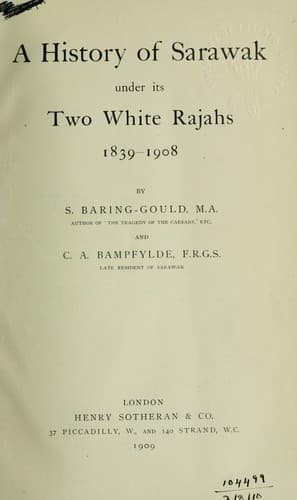
A History of Sarawak under Its Two White Rajahs 1839-1908Baring-Gould, S. (Sabine)
History
A History of Sarawak under Its Two White Rajahs 1839-1908
Baring-Gould, S. (Sabine)
Charles, Rajah of Sarawak, 1829-1917; James, Rajah of Sarawak, 1803-1868; Sarawak (Malaysia) -- History
The village of the Kajaman tribe, a short distance above Belaga.
Footnote 286:
Talip was a Matu Melanau of good birth; Sakalai was a chief of the
Kanowit tribe; and Sawing was half Ukit and half Tanjong.
[Illustration:
A SEA-DAYAK HOUSE OR VILLAGE.]
CHAPTER XI
THE END OF THE FIRST STAGE
[Illustration:
THE RAJAH'S TOMB.]
We are drawing near to the close of the first stage in the History of
Sarawak. It had opened with great hopes. To his mother the Rajah had
written in 1841: "I trust there may be marked out for me a more useful
existence, that will enable me to lay my head on my pillow and say that
I have done something to better the condition of my kind, and to deserve
their applause," and again, "I hope that thousands will be benefited
when I am mouldering in dust," and these hopes have been fulfilled. But
the last period of the Rajah's life was clouded with sorrow,
disappointment, and pecuniary anxieties.
He had practically given up the government in 1863, though he reigned
for five years longer, and could make his will felt when need be. His
health had broken down, and he wrote on May 29, 1863: "I cannot stand
the climate and work," and in that year he left Sarawak for good, having
installed his nephew, the Tuan Muda, as administrator. He was then only
sixty, but for over twenty years his life had been full of anxiety, and
had been a continual struggle against adversities, the most serious
caused by the "malignant and persevering persecutions"[287] of his own
countrymen, to whom he had turned for a little sympathy and a little
help, which would have cost England nothing. In his policy and his
actions he had been guided by no personal ambition; the great desire of
his heart had been throughout the extension of British influence in the
Far East, the improvement of trade, the suppression of piracy, the
horrors of which he had witnessed, and the amelioration of the lot of
the oppressed and suffering natives, whom he had come to love and esteem
for their many good qualities.
With regard to the other countries included in the general policy of the
Rajah, this book has little to do. It suffices to note that had that
policy not been discredited, Siam,[288] the Sulu archipelago, the whole
of New Guinea, and a greater part of Borneo might now have been under
British influence. To the Rajah's unaided efforts, frowned upon at home,
England owes it that Sarawak, Bruni, and Labuan are not now Dutch
Residencies, and North Borneo, through conquest from the Spaniards, an
American colony.
Public-domain text, read in full here on John Shaqi.
Reviews
Reviews
No reviews yet
Be the first to share your thoughts on this work.
Elsewhere in the archive
Join the Discussion
Join the discussion
Sign in to leave a comment or review.
Sign InorCreate an account