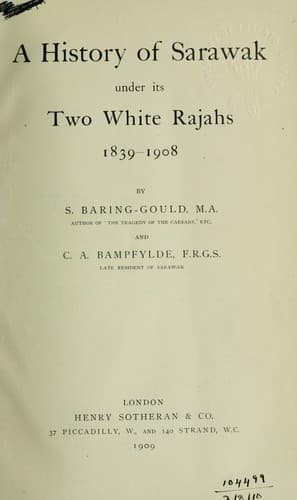
A History of Sarawak under Its Two White Rajahs 1839-1908Baring-Gould, S. (Sabine)
History
A History of Sarawak under Its Two White Rajahs 1839-1908
Baring-Gould, S. (Sabine)
Charles, Rajah of Sarawak, 1829-1917; James, Rajah of Sarawak, 1803-1868; Sarawak (Malaysia) -- History
By his enterprise Sarawak, weakened by civil war and oppression, was
converted into an independent and cogent State, and became a check upon
any further advance of the Dutch northwards; and their strong diplomatic
objections to the Rajah's presence in Sarawak shows what they had in
view. Moreover, the treaty he effected with the Sultan of Bruni in 1847
effectually prevented any settlements other than of an English character
being established in northern Borneo.
From southern Borneo England had retired in favour of the Dutch, and,
previous to this, after the disaster of Balambangan, and its withdrawal
from Bruni, had ceased to take any further interest in northern Borneo,
nor was any attempt made to re-establish its prestige there, or to
suppress piracy, even after Singapore had been founded in 1819. As
usual, England had to wait for a man of action and resolution, and
twenty years afterwards, though, fortunately, when not too late, he
appeared in the person of the late Rajah. Such a man also was Sir
Stamford Raffles, who saved Singapore and the Malay peninsula to
England. It is almost a parallel case.
The members of the East India Board were furious, and the Ministers
of the Crown were "excessively angry." Indeed had it not been for
Raffles ... it is certain that Singapore would have been abandoned
by the British. Raffles made it, and Raffles saved it.... Raffles'
genius and patriotism were rewarded by endless worry, by the
disapproval of his employers, and by public censure from his
country's Ministers.[289]
But the Rajah abandoned the larger policy as hopeless, and devoted his
life and his means to his adopted country; and here the British
Government, influenced by Gladstone, Cobden, Sidney Herbert, and their
Little England followers, did its best to paralyse his efforts.
"My duty has been done at any cost," he wrote sadly, "and the
British Government will be responsible for the consequences which
must follow upon its abandonment of Sarawak. I do not mention the
treatment I have personally received at its hands, for I seek no
favour, nor expect justice, and I shall close a troubled career with
the conviction that it might have been useful to my country and
honourable to myself and a blessing to the native race, but for the
indifference, the inconstancy, and, I regret to say, the injustice
of the British Government."[290]
In an introduction to his nephew the Tuan Muda's _Ten Years in Sarawak_,
written in January 1866, he expressed what had been the ambition of his
life, and his disappointment at its nonfulfilment.
Public-domain text, read in full here on John Shaqi.
Reviews
Reviews
No reviews yet
Be the first to share your thoughts on this work.
Elsewhere in the archive
Join the Discussion
Join the discussion
Sign in to leave a comment or review.
Sign InorCreate an account