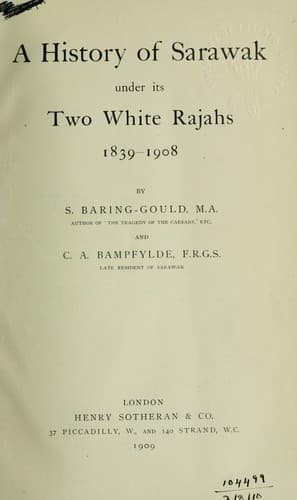
A History of Sarawak under Its Two White Rajahs 1839-1908Baring-Gould, S. (Sabine)
History
A History of Sarawak under Its Two White Rajahs 1839-1908
Baring-Gould, S. (Sabine)
Charles, Rajah of Sarawak, 1829-1917; James, Rajah of Sarawak, 1803-1868; Sarawak (Malaysia) -- History
Charles Brooke was proclaimed Rajah on August 3, 1868, throughout the
territory. The ceremony in the capital and at the out-stations was
simple. The people were assembled, the proclamation read, and the
Rajah's flag saluted. He did not then take the oath, but this was
administered at the next meeting of the General Council, on October 11,
1870, when the Rajah solemnly bound himself to respect the religion,
rights, privileges, and institutions of the people; that no laws or
customary laws would be changed or modified without the sanction of the
chiefs assembled in Council, that he would uphold the late Rajah's will
in respect to the succession to the raj, that the people should have a
voice in the selection of their chiefs, and that all cases arising
amongst Muhammadans in respect to marriage, divorce, and inheritance
should be settled by the Malay chiefs in accordance with Muhammadan law.
At this meeting of the Council the English and native members took the
oaths to endeavour to the best of their abilities to advise truthfully
and justly for the good of the country, and to uphold the authority of
the Rajah. This oath is administered to every new member upon
appointment.
As has been mentioned, the Rajah had already been ruling the State for
five years previous to his accession, and, though troubled with a few
internal disorders among the Dayaks in the far interior, the general
peaceful state of the country, which he had done so much to bring about,
left him free to devote more of his time and attention to many needed
improvements in the administration, and reforms in certain customary
laws, which could only be effected as time smoothed out party feelings,
racial jealousies and distrust, and all had settled down tranquilly
under a government acceptable to the whole population, and which all
were willing to uphold. How the Rajah succeeded as a wise and tactful
administrator, the sure and steady advance of the country, its revenue
and trade sufficiently testify. Not only has this been fully
acknowledged by outside witnesses in a position to judge, but, what he
values more, has won the approbation and confidence of his people.
No one was in a better position to bear testimony to this than the old
Datu Bandar, Haji Bua Hasan, who, in spite of evil report and good
report, won the respect of all classes. As already mentioned, he was a
son of the gallant Patinggi Ali, and was appointed Imaum when Haji Gapur
was degraded, and shortly afterwards was raised to the rank of Datu. He
held his rank and office for over sixty years, and became the trusted
friend of both Rajahs and of all his "English brethren." This is the
simple testimony he bore on the opening of the new Court-house and
public offices during the absence of the Rajah in England, acting as he
did as spokesman for his countrymen, and in the presence of many
hundreds of them.
Public-domain text, read in full here on John Shaqi.
Reviews
Reviews
No reviews yet
Be the first to share your thoughts on this work.
Elsewhere in the archive
Join the Discussion
Join the discussion
Sign in to leave a comment or review.
Sign InorCreate an account