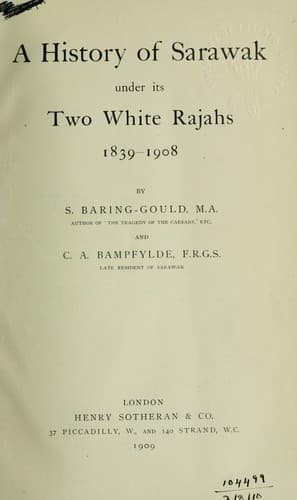
A History of Sarawak under Its Two White Rajahs 1839-1908Baring-Gould, S. (Sabine)
History
A History of Sarawak under Its Two White Rajahs 1839-1908
Baring-Gould, S. (Sabine)
Charles, Rajah of Sarawak, 1829-1917; James, Rajah of Sarawak, 1803-1868; Sarawak (Malaysia) -- History
English brethren, datus, and people all at present within the Court.
I am happy in being here in company with you to hail the anniversary
of the Rajah's birthday, and to join with you in opening this our
new Court-house.
I am here to bear testimony to the fostering care which the Rajah
has ever taken of his children; we, who in years gone by were not
only poor, but sunk under oppression, and heaviness of heart, by his
assistance have become rich, and our hearts have waxed light within
us under the blessing of freedom.
The Rajah is but following out the good work begun by his uncle in
our regard many years ago.
The Rajah, in succeeding his uncle, has not attempted to suppress,
to interfere with, or to decry our religion, therefore I say to you
all, follow that religion truly and adhere to its teachings. Whoever
there be who shall forget what the Rajah has achieved for him and
his, that man is not worthy to be accounted a friend of the
Government, but shall be looked upon as an enemy, and whoever
becomes an enemy of the constituted Government is an offender also
against the faith.
How is it possible for any of us, remembering all that the Rajah has
done for our advancement, to go against him, or in any way to oppose
him. On the contrary, it is our duty—the duty of all of us who
subsist under the Government—to praise the Rajah, to pray for long
life for him and his, and beyond this to ask that he may be blessed
with fortune in his reign, so that we may long live happy, as we are
now, under him.
It will be advisable here to give some account of the manner in which
Sarawak has been and is still governed, in regard to which Sir Spenser
St. John, who was out in Borneo, either in Sarawak or Bruni, for
thirteen years, wrote in 1899:
The Government is a kind of mild despotism, the only government
suitable to Asiatics, who look to their chief as the sole depositary
of supreme power. The influence of the old Rajah still pervades the
whole system, and natives and Europeans work together in perfect
harmony.[295]
For administrative purposes the country is divided into four Divisions,
with a Resident of the 1st Class, or Divisional Resident, in charge of
each, but of late years it has been necessary to appoint only Divisional
Residents to the 1st Division, the smallest in area, but the most
important, as containing the capital; and to the 3rd Division, which
extending from Kalaka to Kedurong Point, takes in about half the State,
and contains about half the population. The Divisions are divided into
Residencies, under charge of Residents of the 2nd Class, with Assistant
Residents, and junior officers under them, all under the supervision of
the Divisional Residents.
Public-domain text, read in full here on John Shaqi.
Reviews
Reviews
No reviews yet
Be the first to share your thoughts on this work.
Elsewhere in the archive
Join the Discussion
Join the discussion
Sign in to leave a comment or review.
Sign InorCreate an account