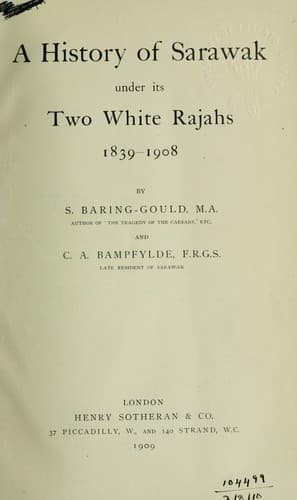
A History of Sarawak under Its Two White Rajahs 1839-1908Baring-Gould, S. (Sabine)
History
A History of Sarawak under Its Two White Rajahs 1839-1908
Baring-Gould, S. (Sabine)
Charles, Rajah of Sarawak, 1829-1917; James, Rajah of Sarawak, 1803-1868; Sarawak (Malaysia) -- History
Thus one was summoned in June, 1867,[296] to meet at Sibu, to discuss
and decide upon the course to be pursued to ensure protection for the
lives and property of Sarawak subjects trading in Bruni territory. A
letter was drawn up by the Rajah in Council to the Sultan, laying the
facts before him, and asking for justice and protection. This drew from
him the rude retort that "the Rajah he knew, but the members of the
Council he presumed were only his coolies."
Nor was this all. When the Rajah's principal Resident, with some of the
leading members of the Council, visited Bruni, the Sultan refused to
allow the latter into his presence, but relegated them to an outer
chamber with persons of low rank.
Hitherto the Sarawak chiefs of all ranks and races had entertained a
lingering sympathy and respect for the "Iang de Pertuan" (He that
rules), the Sultan's more correct title, but these insults completely
alienated their regard.
The details of administration in the out-stations are many and
diversified, and in some of the districts entail a considerable amount
of travelling. The Resident is the chief judicial officer in his
district. He is responsible for the proper collection of the revenue and
for the expenditure. The public works, the police, in fact the general
conduct of affairs throughout his district, are under his supervision,
and he has to be continually visiting the outlying villages. Usually
there is an Assistant Resident and one or more junior officers to assist
him. Besides his usual routine work, he must at all times be accessible
to natives of all races and of all degrees. Though irksome at times,
this duty is one of considerable importance. Some come to complain
against decisions of their chiefs; some for advice and assistance; and
some seek an interview under a trivial pretext, behind which, however,
may be important news, which they would hesitate to deliver before
others. The natives are the eyes and ears of a Resident, and through
them alone can he derive early intelligence of the doings and intentions
of his people. And not a less important duty is to become thoroughly
acquainted with the people under his care, to keep in close personal
touch with them, and to become conversant with their customs and ideas,
for the law he administers must be made more or less consonant with
these. Customs inconsistent with justice and common sense have long
since been discarded for more enlightened rules, but those conformable
to these principles, and suitable to the conditions of the people, have
become recognised customary laws, and these vary among the different
races.
Public-domain text, read in full here on John Shaqi.
Reviews
Reviews
No reviews yet
Be the first to share your thoughts on this work.
Elsewhere in the archive