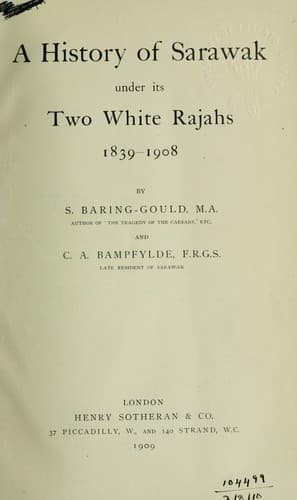
A History of Sarawak under Its Two White Rajahs 1839-1908Baring-Gould, S. (Sabine)
History
A History of Sarawak under Its Two White Rajahs 1839-1908
Baring-Gould, S. (Sabine)
Charles, Rajah of Sarawak, 1829-1917; James, Rajah of Sarawak, 1803-1868; Sarawak (Malaysia) -- History
For the settlement of divorce and probate cases among the Muhammadans,
Courts have been established throughout the State. In Kuching the Court
is presided over by the datus, those in the out-stations by the Malay
Government chiefs, who also sit as magistrates in the Residency Courts.
Such cases are settled in accordance with Muhammadan law, modified as
the Supreme Council may see fit, and subject to appeal to the Supreme
Court.
Beside the permanent and salaried native officers, every Malay and
Melanau village has its tuah,[297] or chief, who is elected by the
people, and, if the selection is approved by the Government, he receives
a commission from the Rajah, appointing him chief for a term of three
years. These tuahs are responsible for the collection of dues and taxes,
and have power as sub-magistrates to settle small cases. As a rule they
are remunerated by commissions, though some receive salaries.
The Sea-Dayaks, Kayans, and Kenyahs have district-chiefs, as already
stated, called pengulus, who are appointed by the Government; and each
house or village has its recognised sub-chief. The powers and duties of
the pengulus are similar to those of the Malay tuahs, and they are
similarly remunerated.
In 1872, certain criticisms upon the administration drew forth a
rejoinder which appeared in the _Sarawak Gazette_ of September 2, and as
it so clearly lays down the Rajah's opinions and his policy we give it
in full:
It is easy enough to find weak places in any system, and to give it
credit on the whole for less than it deserves, because we disapprove
of it in part. It is as easy, especially if one has played an
important part in it oneself, to over-estimate its benefits. But in
a semi-barbarous country, governed in conjunction with the old
native authorities by a knot of foreigners, who are in advance of
those they govern in knowledge and experience, it is hardest of all
to judge impartially what has been done or is in progress. There are
two widely different principles on which such a country can be
judged; we will call them the Native and the European principle
respectively. The first regards the old condition of things,
established by custom and the character of race, as essentially
natural, and is more or less adverse from changes, however slight,
in what has these important sanctions. The second places the
standard of Western civilisation before it, and is apt to judge
rather harshly whatever falls far short of this, or is not, at
least, in a fair way towards attaining it.
Public-domain text, read in full here on John Shaqi.
Reviews
Reviews
No reviews yet
Be the first to share your thoughts on this work.
Elsewhere in the archive
Join the Discussion
Join the discussion
Sign in to leave a comment or review.
Sign InorCreate an account