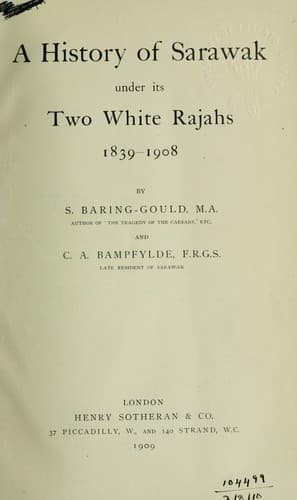
A History of Sarawak under Its Two White Rajahs 1839-1908Baring-Gould, S. (Sabine)
History
A History of Sarawak under Its Two White Rajahs 1839-1908
Baring-Gould, S. (Sabine)
Charles, Rajah of Sarawak, 1829-1917; James, Rajah of Sarawak, 1803-1868; Sarawak (Malaysia) -- History
The policy of ingrafting western methods on eastern customs by a gradual
and gentle process has been attended not only with marked success but
with appreciation by the natives themselves. It has been the means by
which old prejudices have been broken down, and reforms in laws and
administration have step by step, and without friction or difficulty,
been substituted for unjust and debasing customs. By preserving old
customs good in themselves, modifying these where necessary, avoiding
sudden and drastic changes, and, above all, by acting in conjunction
with the native chiefs and in sympathy with their ideas, a faith in the
integrity of the purpose of their white Ruler has been instilled into
the minds of the people, and a feeling that whatever change he may
advise will be primarily for their benefit.
I do not exaggerate, the Rajah wrote in 1870, when I say our chief
success has been owing to the good feeling existing between the
Ruler and people, brought about by there being no impediments
between them; and that the non-success of European governments
generally in ruling Asiatics is caused by the want of sympathy and
knowledge between the Rulers and the ruled, the reason being the
distance and unapproachableness of the Leader. If I were to exclude
myself from Court I must necessarily withdraw myself from hearing
the complaints, either serious or petty, of my people, who would
then be justified in drawing an unsatisfactory and unhappy
comparison between myself and my uncle, who was _de facto_ the slave
of the people, and left the country under _my_ charge expecting me
to carry out _his_ policy.
Changes in laws and customs, which a few decades back would have been
viewed with sullen distrust, are now readily accepted by the Malay
chiefs, even those affecting their own strict religious laws. These as
enacted by Muhammad were adjusted to meet the requirements of the past,
but the Malay chiefs have so far advanced in their ideas that they are
ready to admit that some of these laws may no longer be in accordance
with present conditions. So by an Act passed in the Supreme Council an
important rule contained in that code regulating the succession to
property was modified as being opposed to modern ideas of fairness.
Public-domain text, read in full here on John Shaqi.
Reviews
Reviews
No reviews yet
Be the first to share your thoughts on this work.
Elsewhere in the archive
Join the Discussion
Join the discussion
Sign in to leave a comment or review.
Sign InorCreate an account