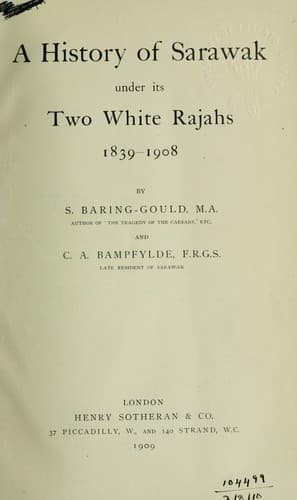
A History of Sarawak under Its Two White Rajahs 1839-1908Baring-Gould, S. (Sabine)
History
A History of Sarawak under Its Two White Rajahs 1839-1908
Baring-Gould, S. (Sabine)
Charles, Rajah of Sarawak, 1829-1917; James, Rajah of Sarawak, 1803-1868; Sarawak (Malaysia) -- History
Before his accession, the Rajah had thoroughly gone into the question of
slavery; in this matter he invited the opinions of all, and on his
accession he was enabled to promulgate certain laws affecting the
slaves, that met with general approval. By these laws, the slave was
protected against ill-usage. He was granted civil rights, and the
privilege of freeing himself by the payment of a small amount, the
maximum price being fixed at about £7, an amount which could easily be
earned by a few months' hard work. The transfer of slaves from one
master to another could be made only in, and with the consent of the
Courts. No slaves could be sold out of the country, and no fresh slaves
might be imported. To quote the _Sarawak Gazette_ of December 12, 1872:
Before the arrival of Sir James Brooke, the Illanuns and other
pirates from North Borneo took yearly trips around the island,
making midnight attacks on peaceful villages, killing old men and
children, separating mother and child, husband and wife, and
carrying away hundreds of miserable wretches to be sold into slavery
in the Sulu archipelago.
In Sarawak territory, Kayans and Melanaus sacrificed slaves to
propitiate evil spirits. To ensure good luck to a chief's new house,
the first post was driven through the body of a young virgin. When
they were afflicted with epidemics, it was the custom to sacrifice a
young girl by placing her in a canoe, and allowing her to drift out
to sea with the ebb tide. At the death of a chief, slaves were tied
to posts near the coffin of the deceased and starved to death, in
order that they might be ready to act as attendants on their master
in another world.[298]
These and a host of other atrocities were formerly enacted here.
Amongst the Malays was found slavery of a milder form. Masters and
slaves were, as a rule, on amicable terms, and the latter were well
treated. Where, however, there was no law, and masters held absolute
power over their slaves,[299] ill-usage occasionally followed as a
consequence; and we could fill pages with stories of cruelties
practised by Malay slave-holders in olden days.
Now on our coast piracy is a thing of the past. Inland, the
barbarities we have described are no longer practised by wild and
superstitious tribes; and although slavery is tolerated amongst the
Malays, it is in such a mild form that the word is a misnomer.
The Government protects the bondman against cruelty and ill-usage,
and acknowledges his legal rights. He can now obtain justice in the
Courts, and by a wise regulation of the Government he can purchase
his freedom at a fixed moderate price, so that should he find his
bondage irksome, he has an opportunity of freeing himself by energy
and hard work.
Public-domain text, read in full here on John Shaqi.
Reviews
Reviews
No reviews yet
Be the first to share your thoughts on this work.
Elsewhere in the archive
Join the Discussion
Join the discussion
Sign in to leave a comment or review.
Sign InorCreate an account