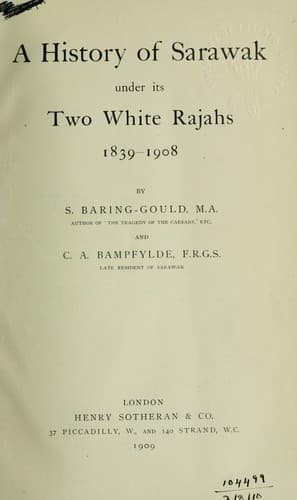
A History of Sarawak under Its Two White Rajahs 1839-1908Baring-Gould, S. (Sabine)
History
A History of Sarawak under Its Two White Rajahs 1839-1908
Baring-Gould, S. (Sabine)
Charles, Rajah of Sarawak, 1829-1917; James, Rajah of Sarawak, 1803-1868; Sarawak (Malaysia) -- History
Both these expeditions were successful, but no particulars of either are
to hand. These expeditions, however, did not result in a final
settlement of these disturbed remote districts. The Dayaks submitted,
only to break out again, and the lesson had to be repeated several
times. It will not be necessary or expedient to give an account of each
of these. There is a tragic monotony about them—so many villages burnt,
so many casualties to the punitive force, so many of the turbulent
natives killed, and then a hollow peace patched up between the tribes
concerned, with the usual ceremonies of killing of pigs.
The Sea-Dayaks still required to be watched and controlled, and "it
would be strange if the Government had not met with difficulties in
keeping in subjection 160,000[301] wild Dayaks, all possessing energetic
souls for warfare." The Saribas, the most troublesome and toughest in
holding out, eventually settled down into the most peaceful and
law-abiding of the tribes, and became great traders, and thoroughly
loyal. This was the case as far back as 1865, and in that year the
present Rajah was able to write: "What an altered country is Saribas to
what it was a few years ago. People are so quiet and peaceably disposed
there now, that never a word of head-hunting is breathed." And the same
may be said of the Sekrangs, who, with the exception of one lapse,
caused by the falsehood and treachery of a once trusted chief, have
remained true and faithful to the Government that had brought them into
subjection. And in regard to all the Sea-Dayak tribes, then as now, it
should be borne in mind that their uprisings, though bringing them into
conflict with it, are never directed against the Government, with the
above exception only, which is related in Chapter XIV. Like the
Highlanders of yore, we may class the various tribes of the Dayaks
having a community of language and customs as clans spasmodically at
feud with one another; and their feuds are confined to the far interior
of the State.
Public-domain text, read in full here on John Shaqi.
Reviews
Reviews
No reviews yet
Be the first to share your thoughts on this work.
Elsewhere in the archive
Join the Discussion
Join the discussion
Sign in to leave a comment or review.
Sign InorCreate an account