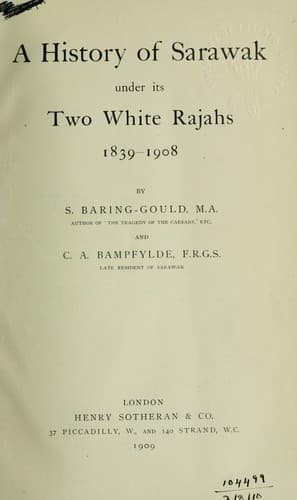
A History of Sarawak under Its Two White Rajahs 1839-1908Baring-Gould, S. (Sabine)
History
A History of Sarawak under Its Two White Rajahs 1839-1908
Baring-Gould, S. (Sabine)
Charles, Rajah of Sarawak, 1829-1917; James, Rajah of Sarawak, 1803-1868; Sarawak (Malaysia) -- History
Besides the supervision of the Treasury, the Military, Naval, and Public
Works departments are under the direct control of the Rajah, his daily
routine in Kuching includes visits to the barracks, to the steamers and
engineer's workshop, and to the jail, all which would be the work of the
early mornings and evenings. The Rajah also presides in the Supreme and
in the Police Courts, hearing and settling all cases and receiving
petitions, and listening to complaints after the cases are disposed of;
seeing all, whoever they are, and whatever their occasion. After Court
he visits the offices of the various heads of departments, and attends
to any business they may have to bring before him. This is also done
when he visits out-stations, and in the absence of the Rajah the same
rule is observed by the Rajah Muda.
But little had been done by the first Rajah towards promoting the
commercial and industrial development of the State. He had, indeed,
induced the Baroness Burdett Coutts to start an experimental farm with
paddy-working mills at Lundu, and an experimental garden near Kuching,
to teach the natives a better system of farming, with the use of the
plough, and to introduce new products. But she had been unfortunate in
the selection of managers; the experiments proved failures, and were
abandoned in 1872.
Agriculture, the mainstay of all tropical countries, chiefly occupied
the present Rajah's mind, but to quote from a speech made by him a few
years after his accession:—
I do not flatter myself when I say that I have tried my best to
advance agriculture, but I have most signally failed, and am, in
consequence, much disappointed. Nevertheless, I still entertain
hopes that the time for its development is not far distant, and I am
prepared to take any pains, to receive any amount of advice, and to
undergo any trouble if only I can see my way to successfully spread
gardens and plantations in the place of our vast jungles.
Many schemes to promote this industry had been attempted, and had
failed; but the Rajah never lost sight of his purpose, and how he was
ultimately rewarded with success a reference to the chapter dealing with
agriculture will show.
We shall now notice the disturbances that occurred in the period
1868-70.
In July, 1868, the Rajah led an expedition against the Delok Dayaks
living in the Upper Batang Lupar for causing trouble over the borders,
and another in May, 1870, against the Beloh Dayaks in the Katibas for
the same reason. The Katibas, who had hitherto been supporters of the
Government, had been led astray by the chief Balang[300] in 1866, who
then laid a well-planned trap to get the Resident, Mr. J. B.
Cruickshank, into his hands to murder him. He was captured by the Rajah,
and taken to Sibu, where he was executed.
Public-domain text, read in full here on John Shaqi.
Reviews
Reviews
No reviews yet
Be the first to share your thoughts on this work.
Elsewhere in the archive
Join the Discussion
Join the discussion
Sign in to leave a comment or review.
Sign InorCreate an account