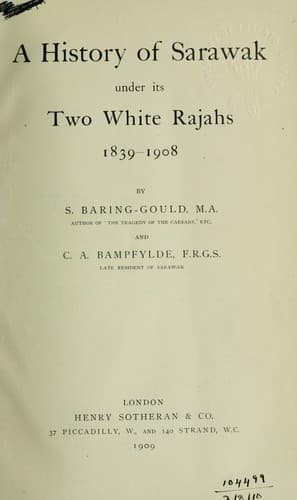
A History of Sarawak under Its Two White Rajahs 1839-1908Baring-Gould, S. (Sabine)
History
A History of Sarawak under Its Two White Rajahs 1839-1908
Baring-Gould, S. (Sabine)
Charles, Rajah of Sarawak, 1829-1917; James, Rajah of Sarawak, 1803-1868; Sarawak (Malaysia) -- History
Mention has been made of the Sepoys. It may be here said how that some
of these men came into the Rajah's service. Many of the Sepoys, who had
been mixed up with the rebellion in India, and were sentenced to death,
had their sentence commuted to penal servitude in the Andamans for life.
The Indian Government proposed to the late Rajah to take charge of some
of these in Sarawak, and to this he consented, and fifty arrived from
Port Blair in March, 1866. There were some soldiers, quite boys, and raw
recruits, some of various other trades, and one or two were of superior
rank. On reaching Sarawak, they all elected to join the military force,
and were distributed among the out-stations. With very few exceptions,
they proved themselves to be a steady and reliable set of men. They were
treated as free men, the only stipulation imposed upon them was that
they were not to leave the country. A few were pardoned and returned to
India, the rest died as pensioners of the Sarawak Government.[304]
On May 13, 1870, an attack was made on Sibu fort[305] by a force of some
3000 Kanowit Dayaks under the noted chief, Lintong or Mua-ari. Sibu
fort, which is situated on an island, was then in the charge of Mr. H.
Skelton,[306] with Mr. H. Brooke Low as his assistant, and was manned by
a force of about thirteen Sepoys. Mr. Skelton had been frequently warned
of the impending attack, but gave no credit to these warnings, and would
allow no extra arms to be loaded. That very evening, during dinner-time,
a noted Dayak chief, Unggat, had come in to inform Mr. Skelton that the
place was to be attacked. Mr. Skelton was angry at being interrupted
during his meal, and vowed, that if no assault was made, the man should
be imprisoned. When the place eventually was attacked, the chief paced
up and down in the fort and would take no part in the defence.
It was the custom of the Sepoys to go out by the back-door before
daybreak to perform their ceremonial ablutions, and of this the Dayaks
were aware, and lay in wait about the exit to surprise them. But the
Sepoys were on their guard, and the door was not opened. The Dayaks then
attacked the fort in force, endeavouring to cut their way in with axes,
but they were beaten off. Amongst the killed was Lintong's eldest son, a
boy who had been the inseparable companion of Mr. J. B. Cruickshank, the
Resident of the Rejang, who was then at home on leave.
Public-domain text, read in full here on John Shaqi.
Reviews
Reviews
No reviews yet
Be the first to share your thoughts on this work.
Elsewhere in the archive
Join the Discussion
Join the discussion
Sign in to leave a comment or review.
Sign InorCreate an account