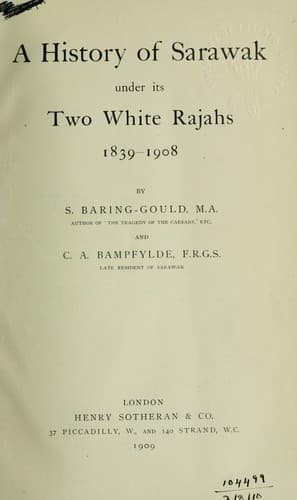
A History of Sarawak under Its Two White Rajahs 1839-1908Baring-Gould, S. (Sabine)
History
A History of Sarawak under Its Two White Rajahs 1839-1908
Baring-Gould, S. (Sabine)
Charles, Rajah of Sarawak, 1829-1917; James, Rajah of Sarawak, 1803-1868; Sarawak (Malaysia) -- History
The Sepoys behaved well, and had to be restrained from going out to
fight the Dayaks in the open. Had the fort been taken, the Chinese
quarters and the Malay villages would have fallen an easy prey to the
Dayaks, and a general massacre would have ensued, as the attack was
timed to take place when all the able-bodied Malays were away on their
farms. This is the sole occasion on which an out-station fort has been
attacked in force, and it revealed to the naked savages the fact that
with their primitive weapons it was futile making such an attempt,
except by surprise. But indeed, on this occasion, a surprise was
intended.
[Illustration:
FORT BROOKE, SIBU
(The Forts at Bintulu, Muka, and Kapit, are similar.)]
Lintong, the troublesome son of a troublesome father, had been a
constant head-hunter, and, before the establishment of the station at
Sibu, a scourge to the Melanaus living in the delta of the Rejang. He
had before attempted to surprise Kanowit fort, and it was from his spear
that Mr. Steele had had a narrow escape. He had, however, fought on the
side of the Government in former days; and, subsequent to the attack on
Sibu, after having been deprived of his liberty for some time, he again
became a supporter of the Government, and eventually a Pengulu. He died
of snake bite in September, 1887.
The Rajah left for England in 1869, and went to reside at Burrator. In
the same year he married Margaret Lili Alice de Windt, his cousin,
daughter of Clayton de Windt, of Blunsdon Hall, Highworth, Wilts, and
Dinnington, Northumberland, and sister to Mr. Harry de Windt, the famous
explorer, who served in Sarawak as A.D.C. to the Rajah in 1872-1873.
[Illustration:
H.H.S. "ZAHORA."]
-----
Footnote 295:
_Rajah Brooke._
Footnote 296:
This was the first meeting of the Council.
Footnote 297:
Literally, an elder.
Footnote 298:
The poor creatures being solemnly admonished to attend well upon their
masters in the next world.
Footnote 299:
They held the power of life and death over their slaves.
Footnote 300:
See chapter x. p. 287.
Footnote 301:
This number includes the Kayan, Kenyah, and other inland warlike
tribes.
Footnote 302:
Afterwards Major Commandant S. R., joined the service 1862, retired
1883.
Footnote 303:
Joined 1868; resigned 1873. He was at this time Assistant Resident of
Bintulu, and was at Muka on a visit.
Footnote 304:
The last in 1902.
Footnote 305:
Built in 1863, when it became the Government headquarters in the
Rejang. Sibu is the most important provincial town, and has a revenue
larger than that of Labuan.
Footnote 306:
Henry Skelton, joined 1866, died in 1873, immediately after being
appointed Resident of Sarawak.
[Illustration:
DARU'L SALAM.]
CHAPTER XIII
BRUNI
[Illustration:
BRUNI CHANANG OR GONG.]
Public-domain text, read in full here on John Shaqi.
Reviews
Reviews
No reviews yet
Be the first to share your thoughts on this work.
Elsewhere in the archive
Join the Discussion
Join the discussion
Sign in to leave a comment or review.
Sign InorCreate an account