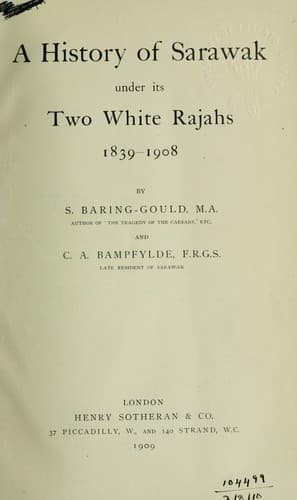
A History of Sarawak under Its Two White Rajahs 1839-1908Baring-Gould, S. (Sabine)
History
A History of Sarawak under Its Two White Rajahs 1839-1908
Baring-Gould, S. (Sabine)
Charles, Rajah of Sarawak, 1829-1917; James, Rajah of Sarawak, 1803-1868; Sarawak (Malaysia) -- History
A good deal has already been said about that blot on the map of Borneo,
Bruni, and of its Rulers, and in this chapter shall be given the history
of the relations between the Sultans and the present Rajah since his
accession, as well as of the policy of the Foreign and Colonial Offices
in regard to that "wretched phantom the Bruni Government."[307]
Many chapters might well be devoted to the past and present history of
Daru'l Salam, the Haven of Peace, the sublime Arabic title by which,
with a characteristic disregard of the fitness of things, the Brunis
proudly dignify their unhappy city, as they do their Sultan with the
title of Kaadil-an, the Just. But like morning dreams, these go by
contraries. The story they would set forth would be a sad one, as may
well be judged from what has already been related and from what will be
told in this chapter, though a great deal more might be said. It would
be interesting, too, as another example of British indifference to
Eastern affairs. From the commencement, when nearly seventy years ago
the attention of the empire was so strongly drawn to this nest of
murderers and robbers, this haven of criminals, by the late Rajah, till
the end, when in 1905 the British Government elected to adopt the
bankrupt and depopulated remnant of the Sultanate, its policy in regard
to that State has been remarkable for neither consistency nor
astuteness.
During the last twenty years of his reign (1852-1885) the old Sultan,
Abdul Mumin, who has been described as having the soul of a huckster,
and who died at the age of over a hundred, devoted his life solely to
the pursuit of wealth, and the unscrupulous means he employed to enrich
himself produced great oppression and misery. Affairs of State were a
secondary matter with him, and the ministers and pangirans went their
ways unrestrained. Some of these pangirans, who are related to royalty,
a few closely, others more or less remotely, exercise "Tulin" or
hereditary feudal rights over districts, the ministers holding,
ex-officio, similar rights over other districts; the unhappy people
therein were completely in their power, and could be squeezed at their
own sweet will. Others, not possessing such rights but armed with
authority from the Sultan, easily obtained at a price, enriched
themselves by forced trading.
The poorer classes of the Bruni Malays are hard-working and law-abiding;
but when no man's property is safe from the rapacious grasp of the
chiefs, thrift and hard work cease to have an object, and the country
becomes dead to industry and enterprise. The inhabitants of the
interior, and the Kadayans, an industrious, agricultural people,
suffered under the same disadvantages. Like the Chinese, these people
once cultivated pepper, but for the same cause gave up doing so, which
is not surprising when even their harvests of rice were not spared to
them.
Public-domain text, read in full here on John Shaqi.
Reviews
Reviews
No reviews yet
Be the first to share your thoughts on this work.
Elsewhere in the archive
Join the Discussion
Join the discussion
Sign in to leave a comment or review.
Sign InorCreate an account