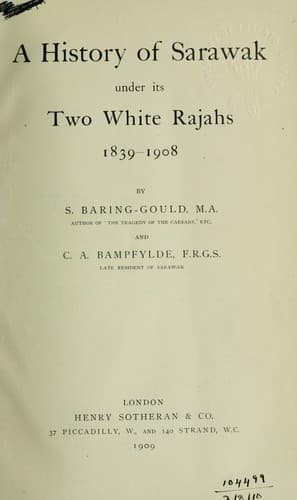
A History of Sarawak under Its Two White Rajahs 1839-1908Baring-Gould, S. (Sabine)
History
A History of Sarawak under Its Two White Rajahs 1839-1908
Baring-Gould, S. (Sabine)
Charles, Rajah of Sarawak, 1829-1917; James, Rajah of Sarawak, 1803-1868; Sarawak (Malaysia) -- History
Although by treaty and by decree the trade of the coast of Bruni
territory was thrown open to all, the Bruni pangirans used their utmost
endeavours to retain it, and traders from Sarawak and Labuan were
incessantly obstructed and interfered with. Competition, coupled with
free trade, was not to the taste of these pangirans, and as the old
Sultan was himself too much mixed up in trading transactions to exert
himself to see that foreign traders received due protection, the
pangirans were left a free hand to deal with them, and their high-handed
proceedings were winked at by Sultan Mumin, if not actually encouraged.
A Sarawak Nakoda, who had been trading with Bruni for some time, was
suddenly attacked when leaving, and fired into by seven boats which had
been lying in wait for him. He managed to escape himself, but lost his
property to the value of $700. His boat was destroyed, and the Sarawak
flag torn to pieces. Orders were sent down the coast closing some of the
ports to Sarawak traders, and imposing prohibitive duties in others. One
order recommended the people to go out of the country and "live under
the white man in Sarawak till they rotted" if they would not pay the
exorbitant taxes demanded of them. Sarawak people, collecting produce in
the jungle, or even when fishing along the coast, had their goods and
boats seized.
In reply to the Rajah's despatches complaining of these outrages, the
Sultan expressed friendship for Sarawak and a desire to foster trade,
and in one or two cases actually made reparation; but he excused himself
in general by his helplessness to enforce his will on the turbulent and
headstrong nobles. And, in fact, the difficulties did not lie in lack of
a clear understanding and of formal agreements, perhaps not in a languid
desire on the part of the Sultan to stand on good terms with the Rajah,
but in the arbitrary conduct of the leading pangirans holding authority
along the coast. Respect for treaties and for fair dealing formed no
part of the mental equipment of these feudal tyrants, and the central
power at Bruni was either too weak, or too timid, or too deeply involved
to interfere with them.
In January, 1870, the Rajah wrote to Lord Clarendon:
"In regard to matters relating to the interests and welfare of the coast
of Borneo to the northward and eastward of the territory under my
control, I am led to understand that her Majesty's Government has no
desire to direct attention to this part, with a view to bringing about a
better system to further the ends of peace and trade, and to relieve the
honester and lower classes from the gross and degraded position to which
they are now reduced by the oppressive measures of the Bruni Government.
H.H. the Sultan permits anarchy and bloodshed throughout his dominions,
and there is no exaggeration in saying that this is carried on within
sight of the British flag at Labuan."
Public-domain text, read in full here on John Shaqi.
Reviews
Reviews
No reviews yet
Be the first to share your thoughts on this work.
Elsewhere in the archive
Join the Discussion
Join the discussion
Sign in to leave a comment or review.
Sign InorCreate an account