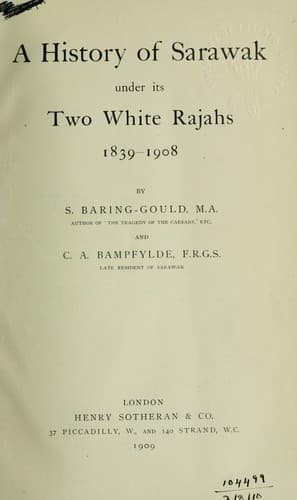
A History of Sarawak under Its Two White Rajahs 1839-1908Baring-Gould, S. (Sabine)
History
A History of Sarawak under Its Two White Rajahs 1839-1908
Baring-Gould, S. (Sabine)
Charles, Rajah of Sarawak, 1829-1917; James, Rajah of Sarawak, 1803-1868; Sarawak (Malaysia) -- History
The authorities at Labuan, which was a fully constituted Crown Colony,
the Governor being also Consul-General for Borneo, were either purposely
blind to what was going on at Bruni, which was but a few miles off, or
were too much hampered in their actions by instructions from home to
effect any reforms in the State. But, to quote from the letter of a
Naval Officer of high rank, "Mr. J. Pope Hennessy" (afterwards Sir John
Pope Hennessy, who was Governor of Labuan from 1867-1871), "had an
object in upholding the Sultan and encouraging him in the oppression of
his subjects, as that caused many to take refuge in Labuan." A little
judicious advice, backed by the immense power which the Sultan and his
nobles knew the Governor had behind him, would have effected much
towards the amelioration of the lot of the natives, but nothing whatever
was done. The Bruni Malays must "stew in their own juice," it was no
concern of her Majesty's Government that Sarawak trade should be
interfered with, for what was Sarawak to Britain? It was no concern of
her Majesty's Government that the Sultan and his pangirans were breaking
the heart of the people, killing the incentive to industry. It looked on
with a cold eye, and with a callous heart.
As a colony Labuan was a failure. Only a few natives and Chinese had
settled there, and there was little trade. Instead of being the medium
through which reforms on the coast might be effected, Labuan for long
stood in the way, by checking the spread of the influence of Sarawak
along the coast. The Foreign Office was guided by the advice of their
Consul-General, and was rarely other than ill-advised, though the late
Sir Henry Keppel "had pleaded the cause of civilisation that the Rajah
of Sarawak should be encouraged and not thwarted in his attempt to
advance." And he expressed "a hope that he might live to see the Sarawak
territory extended to Bruni itself." Mr. J. Pope Hennessy in his address
to the Legislative Council of Labuan in June, 1871, said: "The policy
promulgated thirty years ago by some enterprising and benevolent
Englishmen that the Dayaks could be civilised, and that Europeans could
conduct the details of trade and administration in the rivers of Borneo
has proved to be visionary."
It is easy to imagine what would be the nature of advice tendered to the
Foreign Office upon Bornean affairs by such a man. At the time when he
made this statement Sarawak was in absolute tranquillity, and the trade
of 1870 had nearly doubled that of the preceding year.
And, with exceptions, the Governors of Labuan were always more or less
hostile to Sarawak, because jealous of it. Labuan was stagnant and
Sarawak steadily advancing in vigorous life.
Public-domain text, read in full here on John Shaqi.
Reviews
Reviews
No reviews yet
Be the first to share your thoughts on this work.
Elsewhere in the archive
Join the Discussion
Join the discussion
Sign in to leave a comment or review.
Sign InorCreate an account