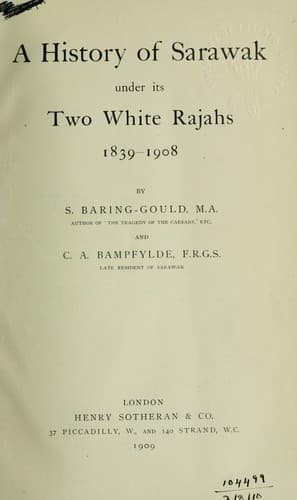
A History of Sarawak under Its Two White Rajahs 1839-1908Baring-Gould, S. (Sabine)
History
A History of Sarawak under Its Two White Rajahs 1839-1908
Baring-Gould, S. (Sabine)
Charles, Rajah of Sarawak, 1829-1917; James, Rajah of Sarawak, 1803-1868; Sarawak (Malaysia) -- History
A policy somewhat similar to that above indicated was, a year after,
inaugurated with great success in the Malay Peninsula, and it would
doubtless have met with equal success in Borneo had it found favour with
her Majesty's Ministers then, though thirty years afterwards they saw
reason to adopt it, but only after Bruni had become a bankrupt State,
stripped of most of its territories, and with its small remaining
revenue pawned. At the time when the Rajah made his proposal, the whole
of what is now the British North Borneo Company's territory, together
with Lawas, Trusan, Limbang, and Bruni, might have been acquired, and
the Sultan would then have become as powerless to do harm as one of the
native princes of the Federated Malay States, thus relieving the people
of the intolerable oppression of a government which had reduced the
population to a small remnant of what it had been formerly.
The policy adopted in regard to the native States of the Malay Peninsula
in 1875, referred to above, is generally known as that of Sir Andrew
Clarke, who was Governor of the Straits Settlements from 1873 to 1875.
It was the policy, however, that the late Rajah, many years before, had
advocated as one which should be introduced into all native States, and
he then wrote: "The experiment of developing a country through the
residence of a few Europeans and by the assistance of its own native
rulers has never been fully tried, and it appears to me, in some
respects more desirable than the actual possession of a foreign nation;
for if successful, the native prince finds greater advantages, and if a
failure, the European government is not committed. Above all it insures
the independence of the native princes, and may advance the inhabitants
further in the scale of civilisation by means of this very independence,
than can be done when the government is a foreign one, and their freedom
sacrificed."
Compare this with the remark made by Sir Andrew Clarke in his speech
before the Legislative Council of Singapore on the government of the
native States: "We should continue a policy not of aggression upon our
neighbours, but of exercising our own influence, and by giving them
officers to help them."
Had the late Rajah's policy been adopted, Sumatra, or that part of it
which had not been relinquished to the Dutch in 1824, might now contain
many States as flourishing as those of the Malay Peninsula. On March 3,
1844, the Rajah wrote: "I was glad of the opportunity I had of seeing
the political state of Achin, as it fully confirmed my views, which I
made known to Sir ——, of the steps necessary to protect and enlarge our
commerce. Achin, like Borneo, is now in such a state of distraction that
no protection can be found for life or property. To protect our trade we
must _make a monarch_, and uphold him; and he would be a British servant
_de facto_. We could always raise the better and depress the worse, in
other words support those who will benefit ourselves."
Public-domain text, read in full here on John Shaqi.
Reviews
Reviews
No reviews yet
Be the first to share your thoughts on this work.
Elsewhere in the archive
Join the Discussion
Join the discussion
Sign in to leave a comment or review.
Sign InorCreate an account