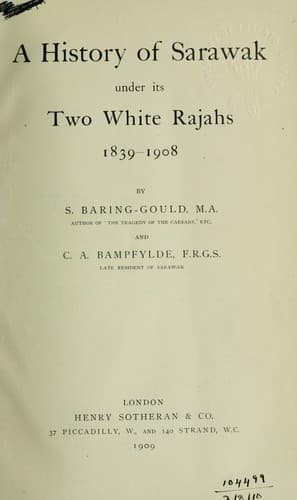
A History of Sarawak under Its Two White Rajahs 1839-1908Baring-Gould, S. (Sabine)
History
A History of Sarawak under Its Two White Rajahs 1839-1908
Baring-Gould, S. (Sabine)
Charles, Rajah of Sarawak, 1829-1917; James, Rajah of Sarawak, 1803-1868; Sarawak (Malaysia) -- History
Her Majesty's Government had refused to interfere in any way with that
of Bruni for the amelioration of the condition of the people, and the
maintenance of open ports and free trade; had stood aloof as not
disposed to interfere in the internal affairs of the Sultanate, and yet
now, most inconsistently, it stepped in to forbid the cession to Sarawak
of a portion of that miserably misgoverned and depopulated State.
The fact seems to have been that the Foreign Office had been
persistently misinformed as to the position and prospects of Sarawak,
and as to the conduct of the Rajah towards the Sultan. The latter had
agreed to the cession of Baram to Sarawak; he desired it for monetary
reasons, the only reasons that appealed to or swayed him. But when Sir
Edward Hertslet informed Mr. H. T. Ussher, C.M.G., who was Governor of
Labuan from 1875 to 1879, and who appreciated the motives which guided
the Rajah, that he "in common with others at the Foreign Office had
fancied that the acquisition of the Baram by Sarawak would lead to the
loss of its sago trade with Labuan," the cat was out of the bag.
Incidently we may remark that Baram exported no sago, and that there
could then have been little or no trade between that river and Labuan,
for during the first six months of Sarawak rule the exports amounted in
value to $9000 only. It was a dog-in-the-manger policy, what Labuan
could not have, that it was resolved Sarawak should not have, and the
interests of the people were left out of the question. It is possible
enough that this was inspired by jealousy. No man likes to see his own
field sterile and that of his neighbour producing luxurious crops.
Conceive the feelings of a small mercer in the same street as a Whiteley
or Harrod, who finds his own business dwindling, and is oppressed by the
extension and success of the great firm a few doors off. Such may have
been the feeling of a Governor of Labuan.
The Rajah visited England in 1874, and on July 16 handed in a memorandum
to the Secretary of State for Foreign Affairs, pointing out that the
appropriation by foreign powers of north-west and north-east Borneo and
the Sulu Archipelago[310] should be guarded against, and recommended to
ensure this, and for the benefit of trade and of the native communities,
that Great Britain should assume the sovereign power over those
territories that remained to the Sultanate of Bruni, that the Sultan and
his heirs should be pensioned, as well as the five principal Bruni
Rajahs; and that a town should be built at the mouth of the Bruni river,
which should become the headquarters of her Majesty's Representative, in
place of Labuan. All that the Rajah asked for Sarawak was that Baram
should be incorporated with that State, owing to the fact that the
inland population of that river and that of the Rejang were greatly
intermixed, and should therefore be under one head and government.
Public-domain text, read in full here on John Shaqi.
Reviews
Reviews
No reviews yet
Be the first to share your thoughts on this work.
Elsewhere in the archive
Join the Discussion
Join the discussion
Sign in to leave a comment or review.
Sign InorCreate an account