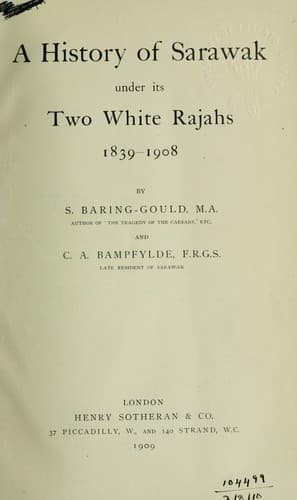
A History of Sarawak under Its Two White Rajahs 1839-1908Baring-Gould, S. (Sabine)
History
A History of Sarawak under Its Two White Rajahs 1839-1908
Baring-Gould, S. (Sabine)
Charles, Rajah of Sarawak, 1829-1917; James, Rajah of Sarawak, 1803-1868; Sarawak (Malaysia) -- History
In June, 1883, the Rajah visited Bruni, and was received by the aged
Sultan with special marks of distinction. The Sultan waited at the
entrance of the audience chamber, and taking the Rajah by the hand, led
him to the throne where he seated him by his side. Negotiations for the
cession of Baram and the rivers and districts lying between that river
and Bintulu were at once entered upon, and speedily concluded, and on
the 13th, the deed of cession was finally sealed and delivered.
The cession of this district gave great satisfaction to the inhabitants,
and most of those who had migrated to Sarawak returned by degrees. A
fort was erected at Claudetown[312] (Merudi) about sixty miles up the
Baram river, and here Chinese and Malay traders soon settled, and a
brisk trade rapidly sprang up. Minor stations were also established at
Miri and Niah. The turbulent Kayans and Kenyahs speedily became
pacified, and existing feuds were settled. Now, this district is one of
the most peaceful and prosperous in the State.[313] The entrance to the
river is, and has been, a great hindrance to trade, the bar being very
shallow and exposed, so that it is unsafe for sailing vessels and screw
steamers. The Government accordingly had a special steamer of 200 tons
built in England to carry the trade. She is practically flat-bottomed,
and is propelled by paddles. Another, larger, was added as the trade
increased. In January, 1884, the Rajah was notified by Earl Granville
that her Majesty's Government had no objection to the exercise of
jurisdiction over British subjects by the judicial authorities of the
Government of Sarawak in this newly-acquired territory.
Public-domain text, read in full here on John Shaqi.
Reviews
Reviews
No reviews yet
Be the first to share your thoughts on this work.
Elsewhere in the archive
Join the Discussion
Join the discussion
Sign in to leave a comment or review.
Sign InorCreate an account