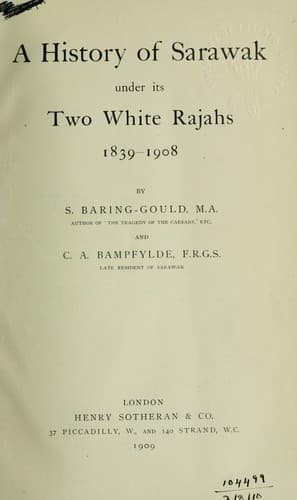
A History of Sarawak under Its Two White Rajahs 1839-1908Baring-Gould, S. (Sabine)
History
A History of Sarawak under Its Two White Rajahs 1839-1908
Baring-Gould, S. (Sabine)
Charles, Rajah of Sarawak, 1829-1917; James, Rajah of Sarawak, 1803-1868; Sarawak (Malaysia) -- History
Only one chief in Baram gave any trouble; and he was Aban Jau, chief of
the Tinjar Kayans. He persistently interfered, and thwarted the policy
of Government as much as he could without bringing himself into open
conflict with the authorities. He maintained a position of
semi-independence, and flew his own flag. But in May, 1884, he committed
an intolerable act, and had to be humbled. As the affair is illustrative
of the iniquities allowed at Bruni until quite recently, the particulars
may be given. To appease the manes of his daughter-in-law, Aban Jau sent
to Pangiran Nipa of Tutong, asking for a slave, so that he might
immolate the unhappy wretch. His messengers went to Bruni, where two
pangirans, Matusin and Tejudin, handed them a slave, an old and decrepit
man, whom they sent as a present to Aban Jau. The Resident at
Claudetown, hearing of this, had the party intercepted and arrested, but
too late to save the slave. He had been killed and his head taken, as he
was too old to walk, and the messengers did not care to trouble
themselves to carry him. Aban Jau was severely punished; he submitted,
and his power was broken. He was no better than an aged savage, and
there was some excuse for him, as he was complying with ancestral
customs; but there was none for the Muhammadan Bruni pangirans for
despatching a miserable old slave to a death by torture.
In June, 1884, by the Sultan's orders, a Dusun village was attacked—the
time for the attack being chosen when nearly all the able-bodied men
were absent, and over twenty women and children were killed. Oppression
became so rife that many refugees crossed the frontier into Sarawak
territory, abandoning in so doing their property and plantations. In
August of the same year, the people of Limbang broke out into open
rebellion.
The Limbang river waters a wide district that is fertile and populous.
The people possessed extensive sago plantations, and were comparatively
prosperous. On this account they were all the more oppressed by the
pangirans. There was no protection for person and property, and women
and girls were carried off to fill the harems of Bruni. This was the
people that suffered such cruel wrongs at the hands of the Pangiran
Makota, and it was in this river that he met his death in 1860.
The trouble began with two of the agents of the Pangiran Temanggong, the
then Regent and heir apparent, being killed whilst extorting taxes. The
pangiran thereupon went up in his steam-launch with a large following,
and proposed that the chiefs should meet him at a certain place and
discuss matters. The proposal was made in guile, his real purpose being
to seize the opportunity for slaughtering them. But these people had had
many years' experience of pangirans and their little ways, and met guile
with guile. The proposal was acceded to, but whilst the pangiran was on
his way to the appointed rendezvous he himself fell into an ambuscade.
Public-domain text, read in full here on John Shaqi.
Reviews
Reviews
No reviews yet
Be the first to share your thoughts on this work.
Elsewhere in the archive
Join the Discussion
Join the discussion
Sign in to leave a comment or review.
Sign InorCreate an account