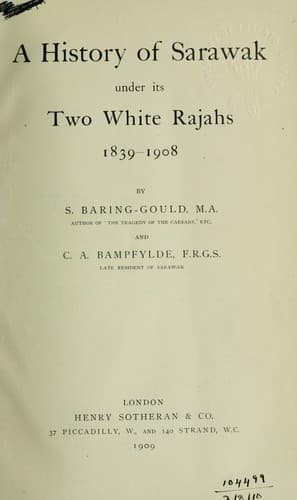
A History of Sarawak under Its Two White Rajahs 1839-1908Baring-Gould, S. (Sabine)
History
A History of Sarawak under Its Two White Rajahs 1839-1908
Baring-Gould, S. (Sabine)
Charles, Rajah of Sarawak, 1829-1917; James, Rajah of Sarawak, 1803-1868; Sarawak (Malaysia) -- History
In December, 1884, Mr. Frank R. O. Maxwell,[314] who was administering
the Government in the absence of the Rajah, when at Bruni heard that
sixteen Sarawak Dayaks and four Malays had been killed while collecting
produce in the neighbouring river, Trusan. The Sultan in his impotence
to act, suggested to Mr. Maxwell his willingness to cede the Trusan
district to Sarawak. The feudal rights over this district were held by
the Pangiran Temanggong, and he too consented. Bruni and Sarawak, he
said, were the same country, and in transferring his rights to Sarawak
he would be incorporating himself in the Sarawak Government. Subject to
the approval of the Rajah, Mr. Maxwell accepted this offer of the
Trusan.
[Illustration:
TRUSAN FORT.]
The Sultan, the Pangiran Temanggong, and other wazirs and pangirans were
then all in favour of the cession of the Limbang, as well as the Trusan,
to Sarawak. The Chinese and Malay traders and the lower classes strongly
advocated the transfer; and the Regent and the wazir next to him in rank
gave Mr. Maxwell a written promise with their seals attached that,
pending the return of the Rajah, Limbang should not be transferred to
any foreign government. On the return of the Rajah early in 1885, Trusan
was occupied, and a fort and station established some thirty miles from
the mouth, to which English and native officers were appointed. The
Muruts up the river were a quarrelsome people, and blood-feuds were
common, and gave some trouble at first. The people generally had become
miserably poor through a long course of oppression.
Trusan is a good example of what tact and discretion can do in dealing
with natives, and the Muruts were the most savage of those in that part.
In a very few years they became peaceful, well-to-do, and contented,
enjoying the fruits of their labours in security. Trusan has now a
fairly flourishing trade, and the rich plains through which the river
winds, and which in days gone by had been extensively cultivated with
rice, but which had been rendered desolate by extortion, now afford
large grazing grounds for herds of water-buffaloes, which are bred for
export, and also excellent land for the cultivation of the sago palm.
Barely a month had elapsed since the peace had been patched up with the
Limbang people by the acting Consul-General, before the people were
again in revolt, and many Bruni Malays, men and women, were killed,
large numbers of buffaloes were mutilated, and again the capital, Bruni,
was menaced. Nothing further was done by the British Government, and
nothing could be done, except to establish a firm government in the
disaffected region, and the Foreign Office was not prepared to do this.
As for the authorities in Bruni, they were incapable of doing anything.
Their only idea of keeping rebellious subjects under control was to
invoke the aid of wild interior tribes, and invite them to butcher and
plunder all who resisted their exactions, and this they could no longer
do.
Public-domain text, read in full here on John Shaqi.
Reviews
Reviews
No reviews yet
Be the first to share your thoughts on this work.
Elsewhere in the archive
Join the Discussion
Join the discussion
Sign in to leave a comment or review.
Sign InorCreate an account