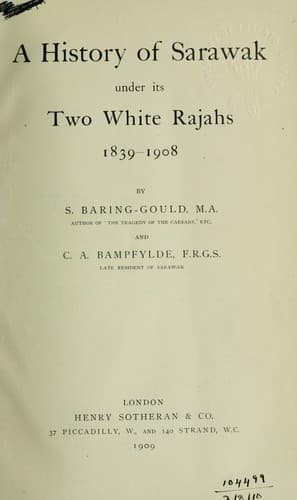
A History of Sarawak under Its Two White Rajahs 1839-1908Baring-Gould, S. (Sabine)
History
A History of Sarawak under Its Two White Rajahs 1839-1908
Baring-Gould, S. (Sabine)
Charles, Rajah of Sarawak, 1829-1917; James, Rajah of Sarawak, 1803-1868; Sarawak (Malaysia) -- History
On May 30, 1885, the old Sultan Mumin departed this life, at the
venerable age of over one hundred years, and the Pangiran Temanggong
Hasim, reputed son of the late Sultan Omar Ali,[315] the predecessor of
Sultan Mumin, was elevated to the throne. Sultan Hasim, who was past
middle age when he succeeded, was a shrewd man, though hard and
vindictive. His antecedents had not been exemplary, but hopes were
entertained that, being a man of strength of mind and of advanced ideas,
an improvement would be effected in the administration of Bruni, which
would lead to the establishment of good order and bring the place and
State out of absolute decay into comparative prosperity, but these
hopes, strong man as he was, he was powerless to fulfil.
In order to appreciate much that occurred during the reign of Sultan
Hasim it is necessary to understand the conditions under which he became
Sultan, and the effect that these conditions had upon his power and
position.
His predecessor, Mumin, had an only son, the Pangiran Muda Muhammad
Tejudin, a semi-imbecile, nicknamed Binjai, literally the son of
misfortune, signifying an idiot. Much as Sultan Mumin would have liked
to have proclaimed his son heir to the throne, it was quite impossible
for him to do so in opposition to the natural objections of the nobles,
upheld, as these were, by the laws of Bruni, which preclude the
accession of any prince afflicted with mental or bodily infirmity. The
succession would therefore fall upon either of the Sultan's nephews, the
Pangiran Bandahara, or the Pangiran di Gadong, and both claimed it.
These two powerful princes and wazirs, with their feudal and official
territorial rights, and the many nobles and chiefs who owed them
allegiance, represented the most powerful factions in the country, and
the accession of either to the throne would have plunged the country
into bloodshed. To avert this, the British Government persuaded Sultan
Mumin, but not without bringing considerable pressure to bear upon him,
to nominate the Pangiran Temanggong Hasim, the senior wazir, as his
successor, and to appoint him Regent, the old Sultan being too
feeble-minded to govern.
Hasim's elevation to the throne gave profound offence to the Pangirans
Bandahara and di Gadong, and to the majority of the people, who believed
the story of his mean birth, and that he had no just title to the rank
he held as a prince of blood royal. That his accession was not disputed
was due only to its implied support of the British Government, though
that support would probably have failed him had he been forced to fall
back upon it. The Bandahara and di Gadong, though they retained their
offices, for many years refused him their support, and would neither
attend his Council nor maintain any kind of relation with him,
notwithstanding the fact that they were his two principal Ministers of
State; and he was powerless to force them to do so, or to deprive them
of their offices.
Public-domain text, read in full here on John Shaqi.
Reviews
Reviews
No reviews yet
Be the first to share your thoughts on this work.
Elsewhere in the archive
Join the Discussion
Join the discussion
Sign in to leave a comment or review.
Sign InorCreate an account