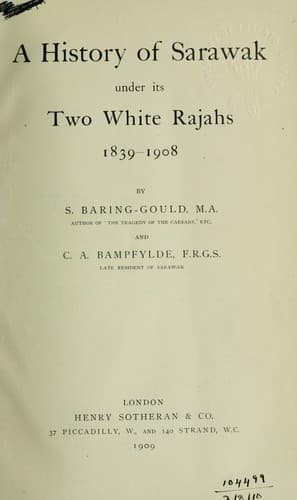
A History of Sarawak under Its Two White Rajahs 1839-1908Baring-Gould, S. (Sabine)
History
A History of Sarawak under Its Two White Rajahs 1839-1908
Baring-Gould, S. (Sabine)
Charles, Rajah of Sarawak, 1829-1917; James, Rajah of Sarawak, 1803-1868; Sarawak (Malaysia) -- History
As we have before pointed out, in the Sultanate of Bruni, there are
various rights claimed. The Sultan has his rights, some districts revert
to the holders of certain offices, and others are under the hereditary
feudal rule of the pangirans. Limbang pertained to this last category.
The Sultan was sovereign, but his sovereign rights consisted in this
alone, namely, to send his agents into the country and squeeze it. The
feudal lords were the pangirans, and as they could not oppress the
exasperated and revolted people any more, they were ready to surrender
their rights to the Rajah, but could not do this without the Sultan's
confirmation and seal. What the Sultan wanted was that the Rajah should
crush the rebellion, so that he might work his vengeance on the Limbang
people, and turn the screw on them till nothing more could be extracted
from them. This the Rajah perfectly understood, and he declined to do
the dirty work for the Sultan. The refusal of assistance by the Rajah
produced a coolness on the part of the Sultan. He would not, however,
receive this refusal as final, and he repeated his request to the Rajah
in an altered form; he requested him to place the gunboat _Aline_ with a
strong force of Sarawak Dayaks, also a large sum of money, at his (the
Sultan's) disposal, for the purpose of enabling him to reduce the
Limbang people under his own officers, if the Rajah himself would not
head the expedition.
The Rajah's refusal aroused an angry feeling in the breast of Hasim, and
this was fanned to bitter hostility, when the Consul-General informed
him and the Limbang people simultaneously, in reply to a petition of the
latter that they might be placed under the rule of white men, that her
Majesty's Government was prepared to consent to the transfer of Limbang
to Sarawak. The Sultan's hostile attitude was not shared by his
ministers, or by the Bruni people generally, or even by the hereditary
owners or rulers of the Limbang. These latter, as has been shown, unable
to extract more taxes from the people, hoped to receive from the Sarawak
Government an annual stipulated income in lieu of precarious and
uncertain exactions. They accordingly begged the Rajah to take over the
river. But the Sultan refused to consent, and his refusal was probably
actuated even then by motives other than those of revenge and resentment
as the sequel will show.
Public-domain text, read in full here on John Shaqi.
Reviews
Reviews
No reviews yet
Be the first to share your thoughts on this work.
Elsewhere in the archive
Join the Discussion
Join the discussion
Sign in to leave a comment or review.
Sign InorCreate an account