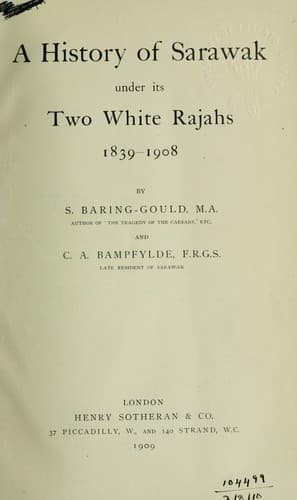
A History of Sarawak under Its Two White Rajahs 1839-1908Baring-Gould, S. (Sabine)
History
A History of Sarawak under Its Two White Rajahs 1839-1908
Baring-Gould, S. (Sabine)
Charles, Rajah of Sarawak, 1829-1917; James, Rajah of Sarawak, 1803-1868; Sarawak (Malaysia) -- History
Moreover, his predecessor had left him in sore straits for the means
necessary for the support of his government, and even of his household.
None of the late Sultan's property came to him, and the whole of the
crown-lands in Bruni territory had been illegally granted to others, and
these, though his rightful appurtenances, he had no power to recover.
Sultan Hasim thus came to the throne practically shorn of everything
that goes to the support of a crown. Abandoned by his ministers, and the
loyalty of his people denied him, deprived of his revenues, and with but
a few followers, there was nothing left him but the sovereign rights,
shadowy in nature since he had not the means fully to exert them. A
pathetic picture; but in spite of his faults it says much for his
personal ability and strength of character that he was able, not only to
maintain his position, but gradually to gain sufficient power to exert
his authority, and to make his will felt. It must not be overlooked that
many of his worst acts were the direct outcome of his necessitous
condition, and the constant intriguing against him by his own ministers.
Owing to lack of power to chastise the rebels, though not of will,
Limbang had been let alone by the Sultan, and for some time there were
no aggressive acts committed by either side, but in November, 1885, the
people of Limbang were again in open rebellion and had killed two more
Bruni subjects. The Sultan thereupon sent the Rajah two pressing
messages asking him to visit Bruni, and this the Rajah did. The Sultan
laid the state of affairs before him, and declared that he saw no hope
of peace unless the Rajah would consent to attack the Limbang, and
reduce the people to order for him. Limbang was sufficiently near to be
a menace to the capital. Twice it had been threatened by them, and the
suburbs raided. The third time might be more disastrous. The town might
fall into their hands.
The Rajah, however, declined to interfere. The Limbang people were at
peace with Sarawak, and numbers of his subjects were working produce in
that river, and met with friendliness there. To reduce these people to
submission, and then to hand them over to oppression, after having
deprived them of the power to protect themselves, was what the Rajah
would never consent to do. That something must be done, and done at
once, he felt, but the question of what should be done was for the
representative of her Majesty's Government to decide.
Public-domain text, read in full here on John Shaqi.
Reviews
Reviews
No reviews yet
Be the first to share your thoughts on this work.
Elsewhere in the archive
Join the Discussion
Join the discussion
Sign in to leave a comment or review.
Sign InorCreate an account