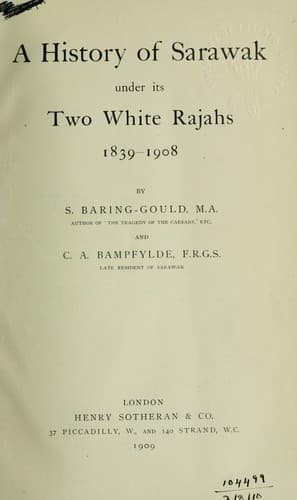
A History of Sarawak under Its Two White Rajahs 1839-1908Baring-Gould, S. (Sabine)
History
A History of Sarawak under Its Two White Rajahs 1839-1908
Baring-Gould, S. (Sabine)
Charles, Rajah of Sarawak, 1829-1917; James, Rajah of Sarawak, 1803-1868; Sarawak (Malaysia) -- History
But in his life of _Rajah Brooke_ published in 1899, Sir Spenser St.
John alters his tone. He remarks that "unless we are to adopt the
principle that 'the end justifies the means,' it is difficult to approve
the action of Sarawak in seizing by force any part of the Sultan's
dominions. A little gentle, persevering diplomacy would have secured
Limbang without violating any principle of international law. I am
convinced, however, that the present Rajah was deceived by some one as
to the political position of that district, as he wrote that, for four
years previous to his action, Limbang was completely independent of the
Sultan, which his officers subsequently found was not the case."
As to the first part of this statement, Sir Spenser when he wrote it,
had severed his connexion with Borneo for nearly forty years, and it
shows how little he was kept in touch with Bornean affairs since he
left; or does Sir Spenser imagine that he would have succeeded where
such men as the Rajah and Sir Hugh Low had failed; both of whom had
continually urged reforms on the Sultan, to which he had turned a deaf
ear?
With regard to the second part of the statement, the Rajah certainly did
not place himself in a position in which he could be deceived. He
conducted all negotiations and all inquiries himself, and on the spot.
He was no more deceived as to the true state of affairs than were Sir
William Treacher, Dr. Leys (Consul-General), Sir F. Weld, and Sir Hugh
Low. It is, moreover, not correct that the Rajah's officers subsequently
made the great discovery that is attributed to them. Sir Spenser might
well have been a little more explicit as to this last remark. He agrees,
however, that there can be no doubt that the inhabitants of Limbang
rejoiced to be placed under the Sarawak flag.
"I knew them well, and how they suffered from the exactions of the
Pangirans, and their rapacious followers, and no one would have more
rejoiced than myself to hear that they had been put under Sarawak rule
in a less forcible way. As poverty increased in Bruni, so had the
exactions augmented, and Limbang, being near, suffered the most. Perhaps
some of my readers may think that in this case the 'end _did_ justify
the means.' At all events, that appears to have been the view taken by
the Foreign Office."
Sir Spenser might very well have accepted the view taken by the Foreign
Office, under which he has served with distinction for many years. The
Foreign Office judged upon facts that were placed before it, and these
facts Sir Spenser had not under his eye when basing this unfair
criticism upon the Rajah's proceedings.
The Limbang having been annexed in 1890, a Government station was
established some fifteen miles from the river's mouth, and settlers,
both Malay and Chinese, soon arrived, and took up their quarters there;
indeed, a good many quitted Bruni, and applied for sites upon which to
build shops and houses directly the flag was raised.
Public-domain text, read in full here on John Shaqi.
Reviews
Reviews
No reviews yet
Be the first to share your thoughts on this work.
Elsewhere in the archive
Join the Discussion
Join the discussion
Sign in to leave a comment or review.
Sign InorCreate an account