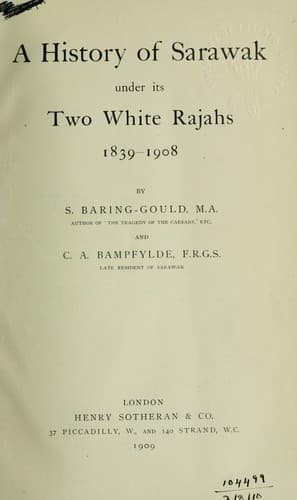
A History of Sarawak under Its Two White Rajahs 1839-1908Baring-Gould, S. (Sabine)
History
A History of Sarawak under Its Two White Rajahs 1839-1908
Baring-Gould, S. (Sabine)
Charles, Rajah of Sarawak, 1829-1917; James, Rajah of Sarawak, 1803-1868; Sarawak (Malaysia) -- History
The station is now a flourishing little place, and has been well laid
out by Mr. O. F. Ricketts,[318] who has been Resident there since its
establishment. It is the prettiest out-station in Sarawak; has miles of
good riding roads, a bazaar that is well attended; and, being another
refuge for the oppressed, the Malay population is continually
increasing. Mr. Ricketts, who also has over-charge of the Trusan and
Lawas districts, has been eminently successful in his management of the
Muruts and Bisayas, of whom he has had some twenty years' experience,
and is popular with all classes at Bruni.
In reporting on Limbang in February, 1891, Mr. Ricketts observes: "since
the occupation of the river in March last, matters have progressed
satisfactorily, and the inhabitants have shown themselves well disposed
and satisfied with the new order of things, with the exception of three
or four of the Danau chiefs, who have been incited to be otherwise from
Bruni.
"Little has been done with the exception of visiting the people, who at
all times have been allowed to trade freely with Bruni; no import or
export duties have been collected. A number of Brunis have come into the
river at different times to wash sago, who previously were unable to do
so, owing to the unsettled state of the place.
"Most of the principal Chinese of Bruni have been over here at different
times, and have expressed their wish to commence business here. One firm
already holds one of the shops, of which there are six, the others being
held by Sarawak and Labuan Chinese; one sago factory is in course of
erection.
"There has been no revenue for the year; the expenditure amounting to
$11,812. No revenue was demanded, until the natives settled down, and
had recovered from their previous unsettled state. The expenditure was
chiefly in public buildings, bungalows, court house, barracks, etc." The
imports and exports in 1906 amounted to $282,277, against only $86,687
in 1891.
There is no fort at Limbang.
Public-domain text, read in full here on John Shaqi.
Reviews
Reviews
No reviews yet
Be the first to share your thoughts on this work.
Elsewhere in the archive
Join the Discussion
Join the discussion
Sign in to leave a comment or review.
Sign InorCreate an account