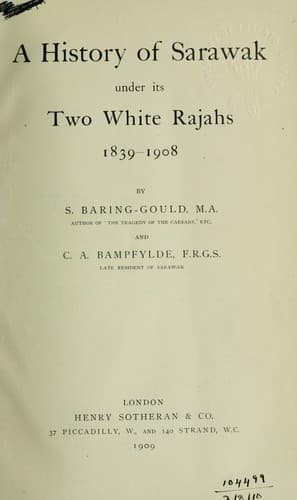
A History of Sarawak under Its Two White Rajahs 1839-1908Baring-Gould, S. (Sabine)
History
A History of Sarawak under Its Two White Rajahs 1839-1908
Baring-Gould, S. (Sabine)
Charles, Rajah of Sarawak, 1829-1917; James, Rajah of Sarawak, 1803-1868; Sarawak (Malaysia) -- History
In October, 1902, many of the inhabitants of Belait and Tutong, unable
to continue the struggle, having sought a refuge in the Trusan and
Limbang rivers, and the Sultan being wearied into granting an amnesty on
the payment of a heavy fine, those remaining surrendered; their
principal chiefs, however, the Datus Kalim and De Gadong, with their
people, elected to place themselves under Sarawak rule by also moving
into the Limbang.
In January, 1905, the British North Borneo Company, with the sanction of
her Majesty's Government, transferred their cession of the Lawas river
to the Sarawak Government. The inhabitants of this river are closely
allied to those of the Trusan, and, in a lesser degree, to those of the
Limbang. It is a beautiful and fertile district, but sparsely inhabited.
If the yearly cession money paid upon the districts that have been
acquired by Sarawak during the sovereignty of the present Rajah is taken
into consideration, not one of these districts has yet paid its way, and
even Limbang, upon which no cession money is paid, showed a deficit of
expenditure over revenue in 1906, but the increased trade, of these
districts, which in 1906 amounted to just a million dollars in value
shows them to be in a flourishing state, and this has added to the
general prosperity of the raj.
In 1905, an agreement was made between his Majesty's Government and the
Sultan, by which the latter accepted a Resident, by whose counsel the
affairs of the State were to be guided, and on January 1, 1906, this
agreement came into effect, and the Sultan and his wazirs were
practically laid aside, the rule becoming British under the _de facto_
ruler, the Resident.
The reason given for this step was not so much that the iniquitous
conditions of affairs at Bruni could no longer be tolerated, but that
the country was bankrupt, and therefore something had to be done. There
were two alternatives presented, the absorption of Bruni by Sarawak, or
the introduction of the same system of government that prevails in the
Federated Malay States. The latter was adopted as being, in the opinion
of the Foreign Office, likely to be more beneficial to the Sultanate, as
well as being a healthy example to the neighbouring protectorates, and
it has been expressly stated by the Foreign Secretary that this was done
not merely with a view to the future interests of Bruni, but to those of
the other British Protectorates in Borneo.[323] The only pretext that
has been advanced for not allowing the natural absorption of Bruni by
Sarawak was the supposed animosity the Sultan bore towards the Rajah,
though, had it still existed, this might well have been regarded only in
the light of a compliment to the latter.
[Illustration:
ON THE LAWAS RIVER.]
Public-domain text, read in full here on John Shaqi.
Reviews
Reviews
No reviews yet
Be the first to share your thoughts on this work.
Elsewhere in the archive
Join the Discussion
Join the discussion
Sign in to leave a comment or review.
Sign InorCreate an account