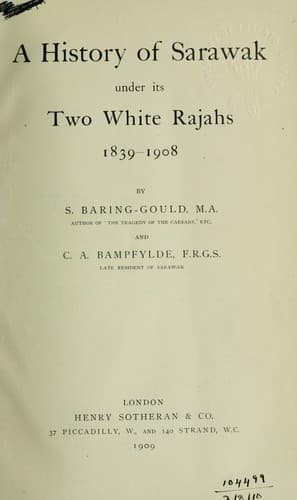
A History of Sarawak under Its Two White Rajahs 1839-1908Baring-Gould, S. (Sabine)
History
A History of Sarawak under Its Two White Rajahs 1839-1908
Baring-Gould, S. (Sabine)
Charles, Rajah of Sarawak, 1829-1917; James, Rajah of Sarawak, 1803-1868; Sarawak (Malaysia) -- History
What these sufferings were, Mr. Keyser, who was Consul at Bruni, fully
sets forth in his report to the Foreign Office for 1899. He wrote: "Such
trade as there was has completely fallen off, and the monthly steamer
from Singapore has ceased its visits. The debts and difficulties of the
Sultan and his chiefs have so increased with time that this state of
affairs naturally reacts upon the people. With the exception of catching
fish, no one does any work, and all live in poverty and constant want of
food. Hundreds of families have left, and continue to leave, to escape
the seizure of their women and children by impecunious headmen, who wish
to relieve their own necessities by selling them as slaves.[320] Others
are driven from the country by the infliction of fines, and the
exorbitant demands of those Chinese and money-lenders to whom the
collection of taxes and all saleable rights have been long since
transferred for cash. Those traders have full power to oppress the
people, and they do so remorselessly. In a short space of time, if the
present Government continues, Bruni will be empty of inhabitants."
The two small provinces, the river districts of Tutong and Belait, now
remaining to the Sultan, have been in a constant state of revolt. In
June, 1899,[321] the people of these rivers openly threw off their
allegiance and hoisted the Sarawak flag, an act which caused some
excitement in the East, and a good deal of comment in English papers.
The principal chiefs then waited upon the Rajah, and begged him to take
over their country, a petition that was repeated shortly afterwards. The
British Consul was informed by them that they absolutely refused to
remain under Bruni rule, and they prayed to be placed under that of
Sarawak. But the Consul could only report; and that Government, which
had "no right and certainly no inclination to interfere," again proved
obstructive, and the people were forced to continue a hopeless effort to
gain their liberty.
A desultory war commenced, weak in attack from want of power,[322] and
weak in resistance from lack of ammunition and supplies. Treachery was
resorted to by those sent to suppress the revolt. As an instance of one
cold-blooded deed, Pangiran Tejudin, the Sultan's son-in-law, of whom
one infamous act has already been recorded, persuaded the inhabitants of
some of the Tutong villages to submit, under a guarantee that their
lives and property would be spared. To ratify the terms, the pangiran
took twenty-five men from these villages to the Tutong town, and there
they were bound and confined. Then one man from each village was
selected, placed bound within a fence, and there at intervals slashed at
until all had bled to death. Seven only managed to escape.
Public-domain text, read in full here on John Shaqi.
Reviews
Reviews
No reviews yet
Be the first to share your thoughts on this work.
Elsewhere in the archive
Join the Discussion
Join the discussion
Sign in to leave a comment or review.
Sign InorCreate an account