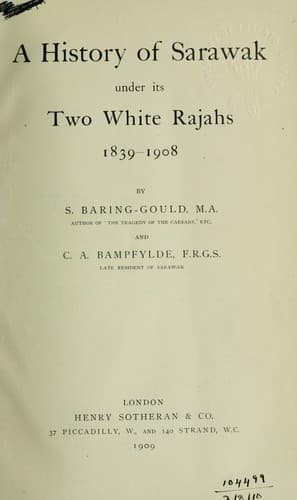
A History of Sarawak under Its Two White Rajahs 1839-1908Baring-Gould, S. (Sabine)
History
A History of Sarawak under Its Two White Rajahs 1839-1908
Baring-Gould, S. (Sabine)
Charles, Rajah of Sarawak, 1829-1917; James, Rajah of Sarawak, 1803-1868; Sarawak (Malaysia) -- History
All who have read these pages will agree there can be no possible doubt
that the Sultan and his ministers had well deserved to have their powers
curtailed, even to the extent of absolute deprivation of all control in
the affairs of their country, but not a few will naturally wonder why
the Foreign Office had not arrived at such an obvious conclusion many
years ago. Then the reasons for interference were tenfold more weighty
than now. Successive years have seen the Sultanate stripped of its
territories, and the capacity of the Sultan and his bureaucracy to do
evil lessened in proportion to the loss of population, revenues, and
power. Then the British Government would have become possessed of a
large territory, nearly as large as England, with a numerous population,
and would have had a reasonable prospect before it of establishing a
State or Colony which might at this time be as flourishing as any of
those in the Malay peninsula; now they have unnecessarily hampered
themselves with a miserable bankrupt remnant of a formerly large State,
some 3000 square miles in area only, with a total population of not more
than 15,000; with no internal resources to develop, and with revenues so
slight as to be inconsiderable, an experiment which appears to be
proving costly.
To contend that the governmental system of the Federated Malay States
would be a good example to Sarawak is to presume a superiority in that
system, and to infer that the conditions prevailing in the former and
latter States are on a parity. So far there has been no convincing
evidence of the superiority of this system in its application to Bruni,
though that is not surprising, as the British Resident can hardly be
expected to make bricks without straw; and Sarawak, which has the credit
of having "the best form of government for a country populated by an
Oriental people of various races," would scarcely be wise to exchange
the simple methods that have been gradually built up to meet the
requirements of her population for an elaborated system, which, however
successful it has been in the States for which it was formed, might not
be altogether conformable to existing conditions in Sarawak. There is
almost as much difference between the populations of the Malay States
and Sarawak, as there is between that of the latter and Java or Ceylon,
and the same difference exists in regard to Bruni. To argue that a form
of government, because it is eminently adapted to the circumstance of
one country would necessarily be suitable to another, is to be
optimistic, and shows a want either of common sense, or of knowledge of
the respective conditions of the countries indicated.
Public-domain text, read in full here on John Shaqi.
Reviews
Reviews
No reviews yet
Be the first to share your thoughts on this work.
Elsewhere in the archive
Join the Discussion
Join the discussion
Sign in to leave a comment or review.
Sign InorCreate an account