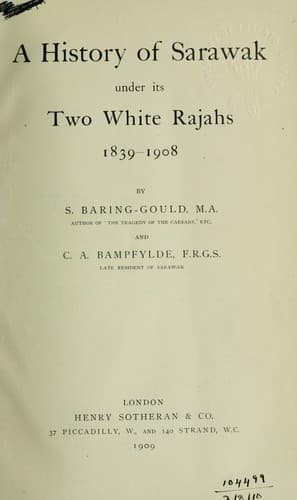
A History of Sarawak under Its Two White Rajahs 1839-1908Baring-Gould, S. (Sabine)
History
A History of Sarawak under Its Two White Rajahs 1839-1908
Baring-Gould, S. (Sabine)
Charles, Rajah of Sarawak, 1829-1917; James, Rajah of Sarawak, 1803-1868; Sarawak (Malaysia) -- History
The levying of such a "harsh and oppressive"[326] tax, was not only
unjust, but distinctly contrary to the terms of the deed under which the
Rajah holds his concession. Whilst protesting against the assumption
that the Bruni Government has the right to impose such a duty, the Rajah
informed the Colonial Office that if it was insisted upon he would be
compelled practically to close down the colliery. In the House, Sir
Edward Sassoon pointedly asked the Under-Secretary for the Colonies "on
what principle such a tax would be imposed upon a nascent industry which
is being created at a sacrifice in an impoverished country, while on the
other hand his Majesty's Government has recently withdrawn the duty
levied on all coal exported from Great Britain." To this question no
direct reply was or could have been given, but it was not until a year
afterwards that the Colonial Office decided that the tax would not at
present be imposed.
The reason given for the imposition of this tax was that all other
sources of revenue at Brooketon having been hypothecated to the Rajah,
it was therefore necessary to levy export duties. It has already been
stated (p. 357) how these revenues had reverted to the Rajah, but it
must not be supposed that they had been obtained for little or no
consideration. To protect his own interests by guarding against any
imposition of harassing taxes, the original lessee of the Brooketon
Collieries had leased the revenues of the district from the Sultan for
an annual sum, and this rent was subsequently capitalised by the payment
of a sum of money equivalent to ten years' rent; thus these revenues
passed from the Sultan's hands for ever, and subsequently became vested
in the Rajah by purchase. A careful consideration of the deed by which
these revenue rights were granted, combined with a competent knowledge
of the prerogatives of the Sultan, would leave little doubt in an
unprejudiced mind that the imposition of any import or export duties at
Brooketon by others than the Rajah would be an infringement of the
rights conveyed by that deed. The revenues derived by the Rajah under
this deed (and he has not exerted his powers to increase them) represent
but a very small return as interest on the purchase money; yet in face
of such kindly moderation, we find the Colonial Office attempting to
impose a tax on the Rajah's property, which would yield to them more
than three times the amount of the legitimate revenue arising from a
benevolent enterprise.
Public-domain text, read in full here on John Shaqi.
Reviews
Reviews
No reviews yet
Be the first to share your thoughts on this work.
Elsewhere in the archive
Join the Discussion
Join the discussion
Sign in to leave a comment or review.
Sign InorCreate an account